


Free Shipping All Orders Over $95
If heat is what converts THCA into THC, why does the hottest bake so often produce the weakest jar?
Because that same heat is working on everything else in the flower. The reaction you want and the losses you don't want run on the same clock, and turning the dial up speeds both of them.
Most recipes skip that part. A single set-and-forget temperature treats decarboxylation as a switch, when it's a curve with a peak. Push past the peak and you've driven off the cannabinoids and terpenes you were trying to protect.
Doing how to decarb THCA flower well comes down to three things: a temperature you've verified rather than assumed, a time you measured, and a lab test in place of guessing from the smell.
I treat 131°C for 65 minutes as the default, in an oven checked with a separate thermometer rather than the dial. Published optimization work on THC-dominant flower uses that time-flexible benchmark, and the same work puts the shorter preferred condition for THC production at roughly 137°C for 57 minutes. The rows below are variations on that pair, not a menu of equally safe bets.
Cultivar, moisture, oxygen, grind size, and how much aroma you are willing to spend all move the result. The 2016 vacuum-oven study of cannabis extracts heated material at 80°C, 95°C, 110°C, 130°C and 145°C for as long as 60 minutes and measured nine cannabinoids. It observed first-order kinetics at 80°C and 95°C through the whole tested period, and at 110°C and 130°C until decarboxylation was complete. A recipe copied off a dial fails when the oven runs hotter than that setpoint.
| Method | Temperature | Time | Trade-off |
|---|---|---|---|
| Low oven | 80°C | 60+ minutes | Gentlest heat; partial conversion |
| Oven | 131°C | 65 minutes | Balanced default when time is flexible |
| Oven | 137°C | 57 minutes | Shortest run for THC-dominant flower |
| Oven | 150°C | Stop at the first sign of darkening | High conversion on paper; highest degradation risk |
| Sous-vide or slow-cooker water bath | ~95°C | 60+ minutes | Gentle reference point, not a research-validated setting |
The 80°C row buys flavour, not maximum strength. An hour there still drops THCA, but conversion stays partial. Choose it when aroma matters more than a heavy result, and plan on more flower per serving.
131°C for 65 minutes is where I land for most home bakes. Long enough to convert a solid share of the THCA, cool enough that neutral cannabinoids are not held in a harsh oven for a long stretch. When the clock is tight, 137°C for 57 minutes shortens the bake without a large jump in heat. Home ovens often overshoot the setpoint by more than that gap, which is how a "little hotter" batch goes dull.
The 150°C row is the one to treat with suspicion. It is described as reaching a high THCA-to-THC conversion, which looks like the winner until you set the degradation risk beside it. Use it only in an oven whose true temperature you have confirmed twice, and pull the tray at the first darkening. A water bath near 95°C, held an hour or longer, is the gentle option if you want steady heat without an oven's cycling. That is common practice, not a validated setpoint.
Whichever row you start from, moisture, particle size, airflow and starting THCA concentration still shift the jar. Most weak batches are over-heated past the point where extra conversion is eaten by losses of THC and terpenes. A timer that hits high conversion is not the same as the strongest flower in the cupboard.
A hotter oven converts more THCA and can still leave you with less THC.
Two reactions run side by side. Heat removes the carboxyl group from THCA, carbon dioxide leaves, and what remains is psychoactive delta-9 THC. Conversion depends on temperature and time rather than happening in one instant, so you are always choosing a point on a curve.
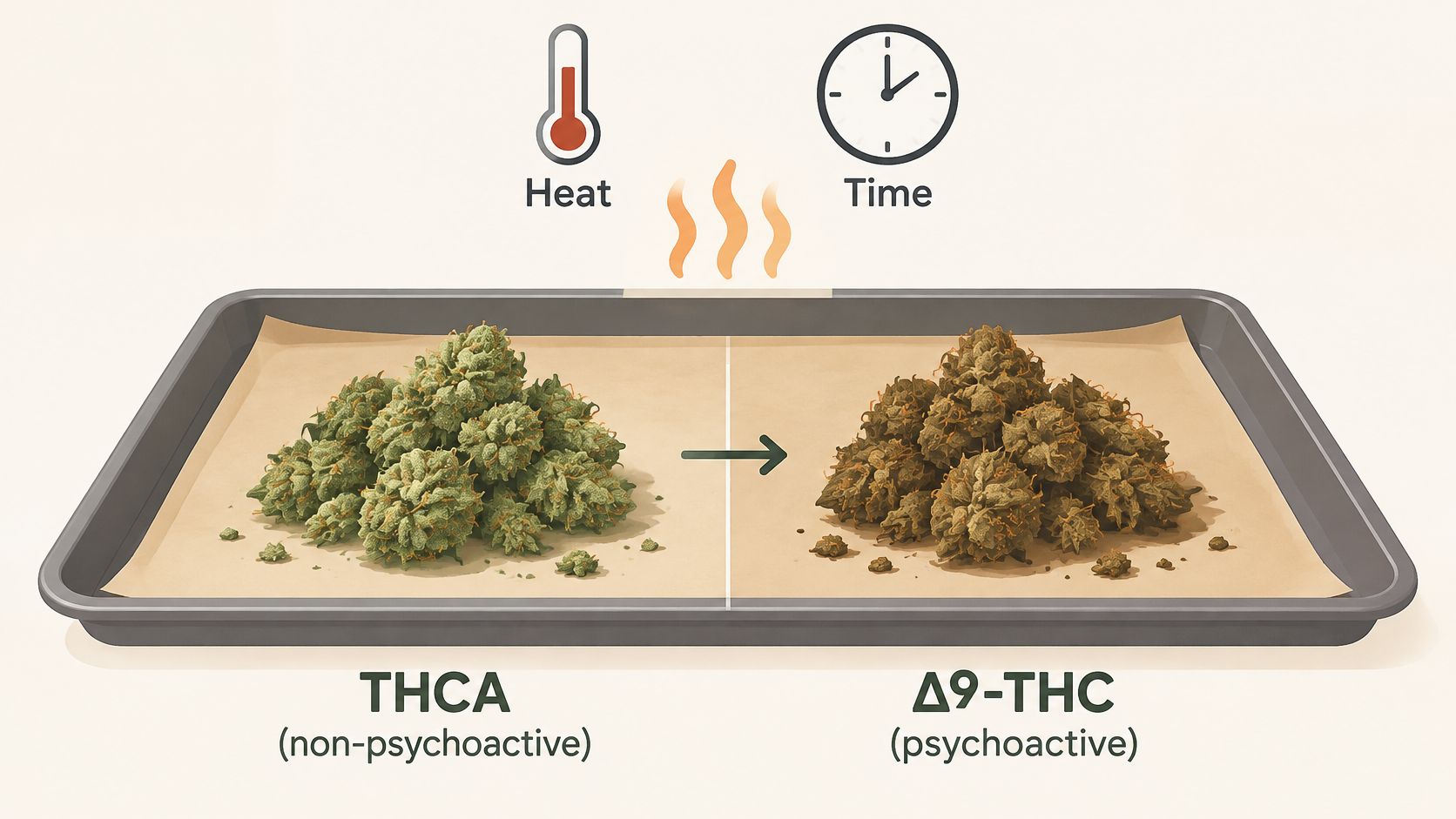
A comparative kinetic study of hemp plant material ran temperatures from 80°C to 160°C for periods of 5 to 120 minutes. THCA followed first-order reaction kinetics and decarboxylated faster than the other acidic cannabinoids the researchers examined. That same study found higher temperatures and longer heating caused significant losses of neutral cannabinoids.
Read that as a trade-off, not a finish line. Complete conversion on paper is not the strongest batch, because the delta-9 THC you just made sits in the same hot environment that created it. Longer heating keeps degrading THCA and the cannabinoids around it, and even moderate temperatures cause measurable loss over an hour. The reaction does not stop when conversion looks finished. It keeps moving toward loss.
The study also reported that cannabinoid losses dropped under oxygen-limited conditions. A covered or low-airflow setup can beat an open tray at the same temperature. I would rather stop short of full conversion than cook off the THC the heat just produced.
Spread 3.5 grams of flower across the bottom of a deep ceramic dish. The edges sit half a centimetre deep. The centre sits nearly two. Heat reaches the edges quickly and pushes them toward degradation while the middle is still climbing and under-converting. One tray, two different products.
A crowded tray fails by a different route. Flower heaped in a corner insulates itself, so the centre of that pile lags behind everything around it. A flat metal tray and a single layer with space between pieces fixes both problems at once.
Terpenes are the other loss. They're volatile, and the airflow that carries heat across the tray also carries aroma out of the kitchen. Every extra degree and every extra minute costs flavour, which is why a hot open bake smells strong and tastes flat. This guide to how terpenes work covers the chemistry and why that loss changes the finished experience.
The working rule: moderate heat, controlled airflow, small batches, then a lab test. High conversion is a target you can overshoot.
The chemistry forgives small mistakes. Your kitchen won't. Run these six checks before the oven comes on.
A bake you can't supervise is a bake you shouldn't start.
The oven method earns its popularity because it's controllable. It goes wrong when the tray is crowded, the temperature is guesswork, or nobody set a timer.
The visual below runs through the process from breaking the flower down to keeping the aroma intact.
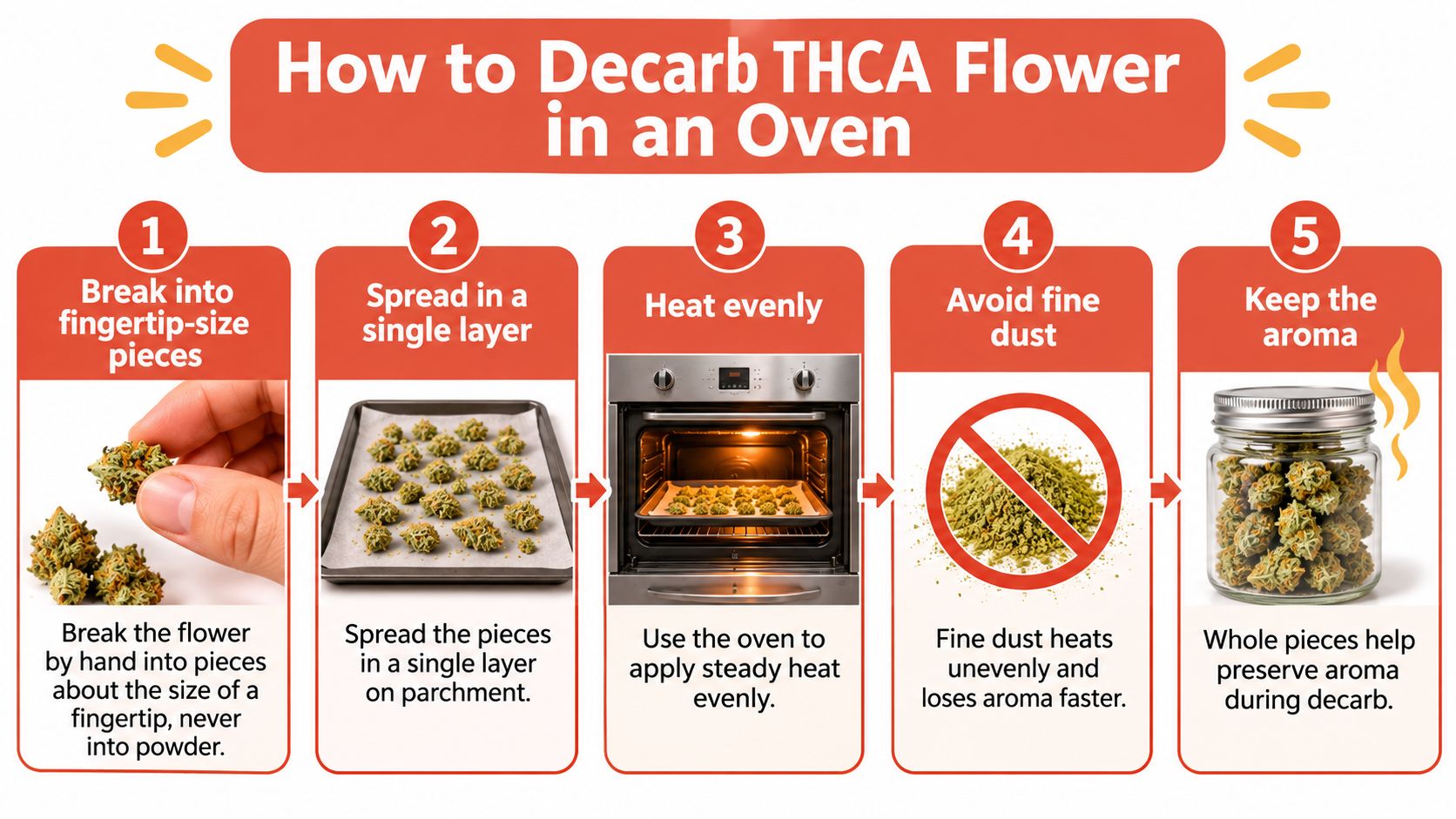
Those figures are benchmarks, not promises. Moisture, particle size, airflow, starting THCA concentration and the accuracy of your equipment all change the outcome, which is why the oven display is the first thing to distrust and an independent probe is the second purchase you make. The next thing to distrust is colour. Browning doesn't prove the bake finished, and a pale tray doesn't prove it didn't. Only validated laboratory testing tells you residual THCA and actual THC.
A finished batch looks slightly darker than it went in, feels dry to the touch, and smells toasted rather than burnt. If the pieces have gone dark brown at the edges or the smell turns acrid, you ran too hot or too long. For commercial production, use a validated time and temperature profile and compare pre- and post-process cannabinoid assays instead of leaning on appearance or a nominal recipe.
If watching the timing play out helps more than reading it, this walkthrough covers the same ground.
When a batch does come out wrong, the symptom usually points straight at the cause.
| Symptom | Likely cause | Fix |
|---|---|---|
| Lab shows high THCA left over | Heating too short or too cool | Re-bake at a verified temperature and retest |
| Burnt smell and dark brown flower | Overheating or long residence time | Lower the temperature and cut the time |
| Weak aroma after baking | Terpene loss from hot airflow or oxygen | Use a closed container and avoid high heat |
| Uneven results across one batch | Heaped flower and uneven heat | Spread the flower in a single layer |
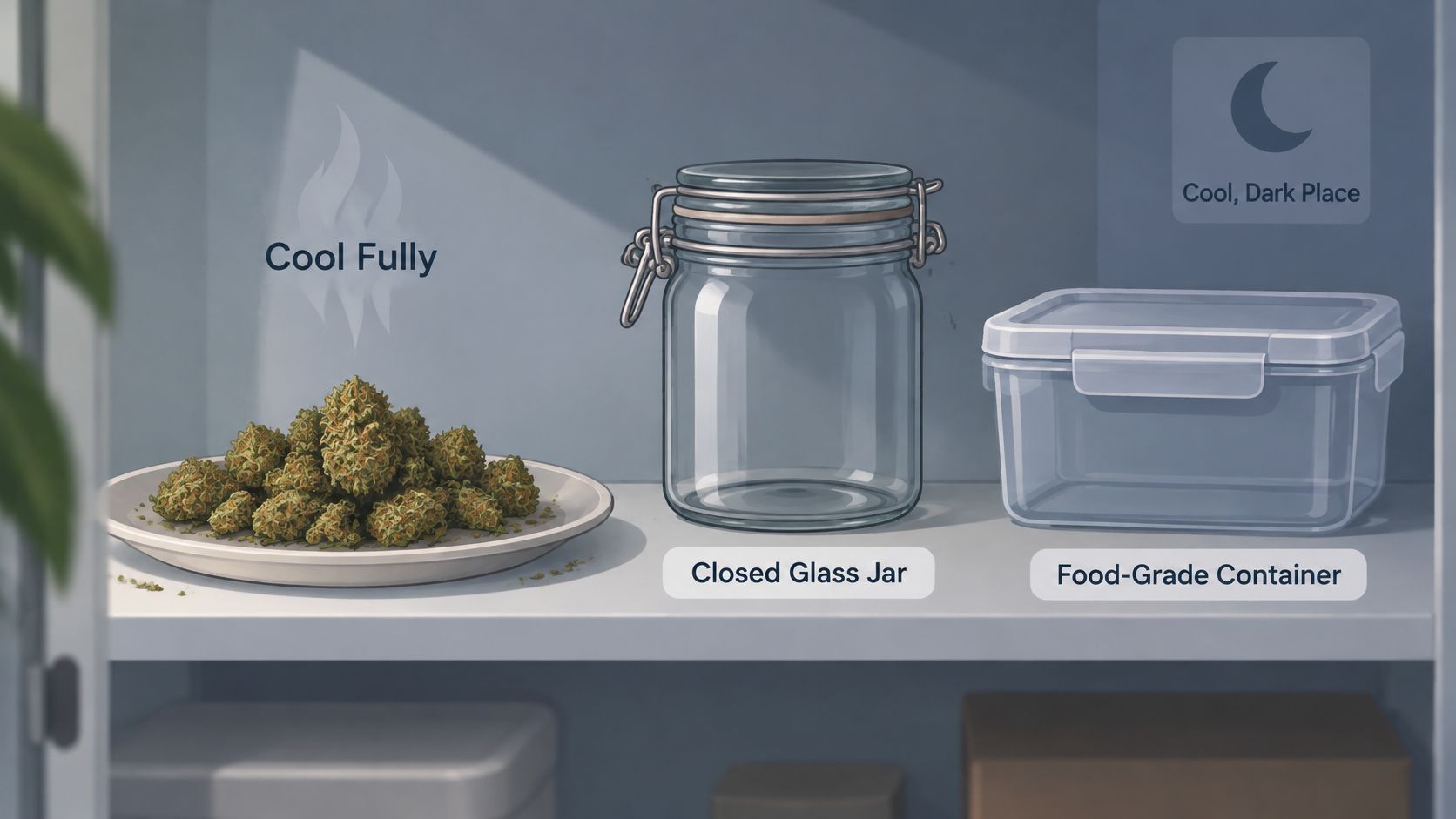
Cool it before you seal it. A warm jar traps moisture against the flower and speeds up the oxidation you just spent a bake avoiding.
Use glass or a food-grade container with a tight lid, and keep it in a cool, dark cupboard. Not the shelf above the oven, not a sunny windowsill. Warmth keeps nudging the chemistry along after you've taken the tray out, and light degrades what's left.
The shelf below shows the setup that protects a batch.
Write the bake date, oven temperature, time and batch weight on the lid. A jar marked "131°C, 65 min, 3.5 g, 12 March" tells you everything when you test it three weeks later. A jar with nothing on it tells you nothing, and you'll end up re-testing a batch you'd already characterised.
Every time you open the jar you swap the trapped air for room air and humidity, so take what you need and close it again. Grind only what you're about to use, since ground flower has far more surface area and sheds aroma much faster. If you're infusing, add the decarbed material to butter or oil once it has fully cooled so the heat you already applied isn't wasted on a second cycle. The full method for how to store THCA flower covers container choice and light exposure in more detail.
Storage protects what the bake already set. Aroma is the first thing to fade from a jar left warm or open, and it doesn't come back.
You cannot see conversion. Colour, dryness and smell are proxies, and every one of them can look right on a batch that still holds most of its THCA.
A certificate of analysis is the only reliable check on what happened in the oven. If the line items and the conversion math leave you squinting, this walkthrough of how to read a certificate of analysis breaks the report down field by field. The five checks below are the ones that matter.
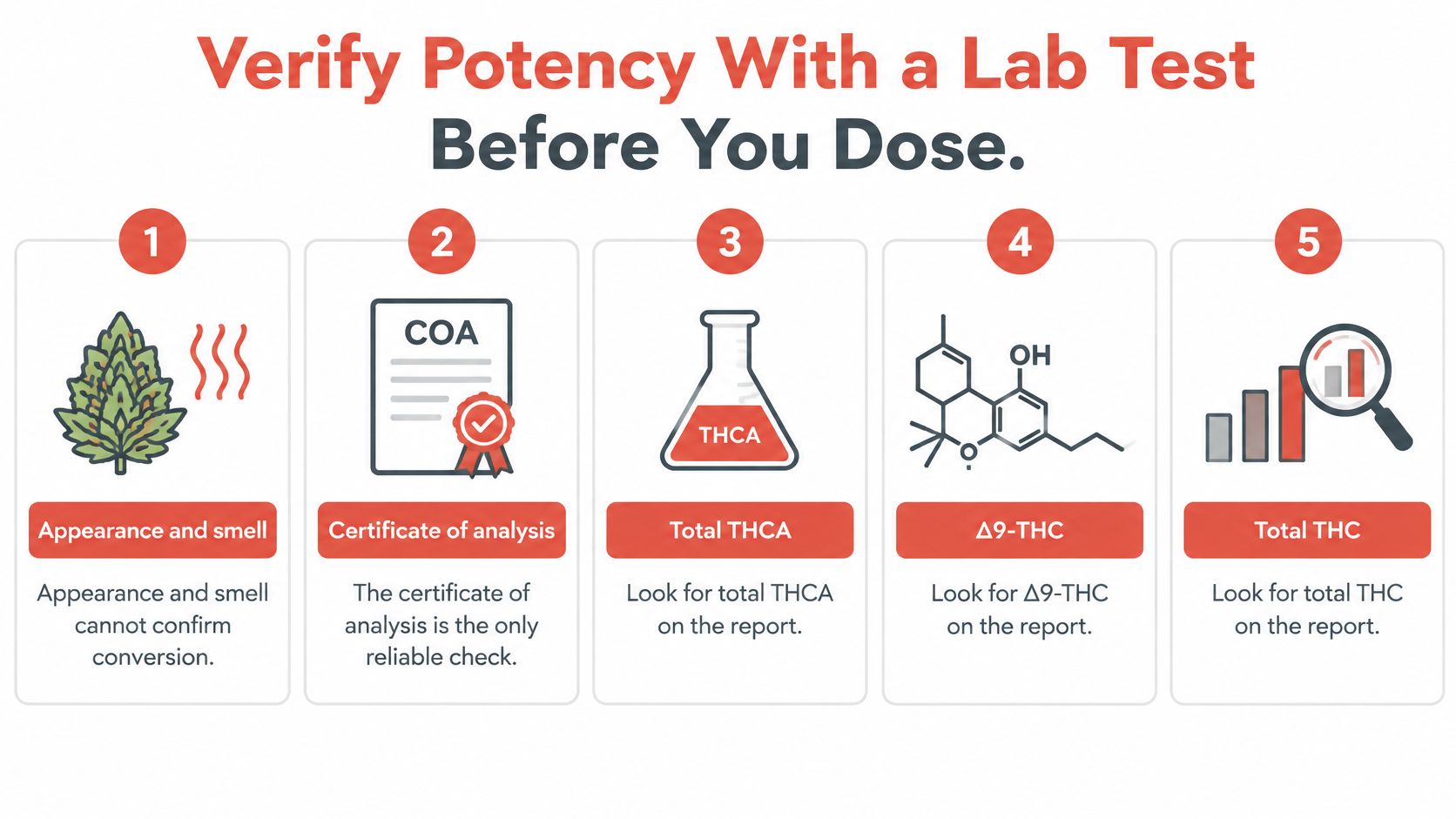
The report needs to show total THCA, delta-9 THC and total THC, plus the test date, the batch number and the laboratory's name. If any of those is missing, the document is decoration rather than data. The pre-bake figures are your starting line: our ounces test between 22 and 26 percent THCA, which sets the value your bake is working from before any heat is applied.
Then compare. Send the same batch before and after the bake so the two assays sit side by side, and retest whenever the method, the oven or the cultivar changes. A recipe that worked on one cultivar tells you very little about the next one, and a converted oven that hasn't been re-checked tells you nothing at all.
The only number that matters is the one from your own batch. Somebody else's perfect result is a starting point, not a result.
Work through this before you trust any figure:
The next step is small and specific. Bake one test batch using the settings above, send a sample for testing, and only scale up or dose once the numbers on the report match the target you set. One jar, one test, one set of numbers you can repeat.
Melt ships lab-tested THCA flower in 3.5 gram jars and in bulk sizes, with third-party reports behind every batch, so you know the starting THCA number before the oven comes on. The lineup covers Boutique Craft, Premium Indoor and Sungrown flower, and each jar carries the strain and potency detail you need for a bake log. Visit Melt to browse the current flower and pull the lab reports for yourself.
Your cart is currently empty.