


Free Shipping All Orders Over $95
It's 10:40 pm and the gummy you ate at nine still hasn't landed. You check the clock a fourth time, feel a faint pressure behind the eyes, and decide the label oversold it. So you take another half.
That second half is where most rough edible nights begin. Swallowed THC doesn't reach your blood the way inhaled THC does. It takes a slower route through the gut and the liver, and the liver converts a slice of it into a second active compound before any of it gets near your brain.
Why do edibles hit harder than a vape carrying the same stated milligram count? Mostly because of that conversion and the clock around it, not because the gummy secretly holds more THC than the label admits. The same dose can also feel mild one week and overwhelming the next, which is the part most dosing advice skips.
Two people take 10 mg of THC. One vapes it, one eats a gummy. Ninety minutes in, the vaper is coming down and thinking about dinner. Three hours in, the gummy eater is still climbing and vaguely surprised about it.
That's not a dosing mistake. Inhaled THC crosses from lung tissue into the bloodstream within minutes. Swallowed THC has to survive the stomach, pass through the intestinal wall, and go through the liver before it reaches general circulation, and the liver alters part of it on the way.
Inhaled vs edible cannabis, timing and metabolite profile
| Factor | Inhaled cannabis | Edible cannabis |
|---|---|---|
| Onset | Within 0 to 10 minutes | Roughly 30 minutes to 2 hours |
| Peak blood level | Within minutes of inhaling | About 2 to 4 hours after eating |
| Duration of effects | About 2 to 4 hours | About 6 to 12 hours, sometimes longer |
| 11-OH-THC to THC plasma ratio | As low as 1:20 | Approximately 0.5:1 to 1:1 |
| Oral THC bioavailability | Higher and far less variable | Roughly 6 to 10% |
Read the onset row as a planning tool rather than a warning. Inhaled effects arrive inside ten minutes, so you can judge intensity almost immediately. Edible effects arrive across a window of 30 minutes to 2 hours, and judging too early is where the trouble starts.
The peak and duration rows explain the shape of the experience. Inhaled THC peaks within minutes and then falls. Swallowed THC and its metabolite may not peak until roughly 2 to 4 hours in, and a longer exposure window means a longer ride, measured in hours rather than minutes.
The last two rows carry the most confusion. The ratio row shows how much active metabolite your body builds relative to unchanged THC. The bioavailability row shows how much of the swallowed dose reaches your blood at all, roughly 6 to 10% according to a review of oral cannabis pharmacokinetics, and that figure shifts between people and between products.
Low, variable numbers like those get misread as reassurance. A small fraction arriving slowly, through a metabolic detour, is exactly what makes timing so hard to judge. For a fuller side by side of how the two formats behave in everyday use, our edibles versus smoking comparison covers the trade offs.
Think of the liver as a customs checkpoint between your gut and the rest of your body. Every molecule you swallow stops at the desk before it can circulate, and the officers don't wave things through untouched. They chemically alter a portion of what arrives, then release the changed and unchanged versions together.
The full route from stomach to bloodstream looks like this.
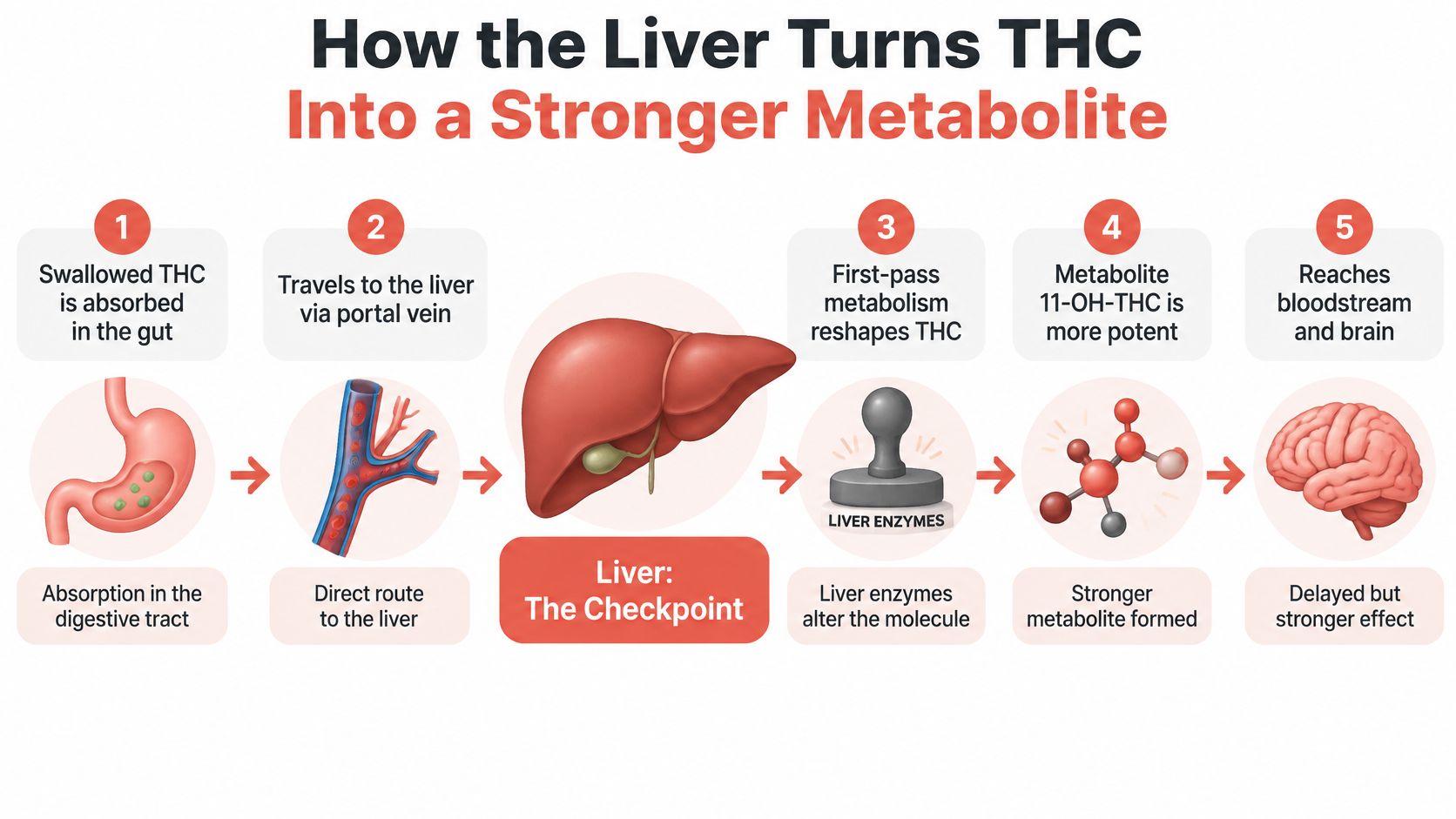
The size of that conversion is the number worth carrying around. A peer-reviewed pharmacokinetic review reports that the 11-hydroxy-THC to THC plasma ratio can be as low as 1:20 after inhalation but rises to roughly 0.5:1 to 1:1 after oral administration. Smoking gives you about one unit of the metabolite for every twenty of THC. Eating can give you anywhere from half a unit to a full unit for every unit of THC.
The short version: the label tells you how much THC went in. Your liver decides how much of it comes back out as something else.
Timing compounds the effect. The same review describes clinical guidance putting oral onset at roughly 1 to 3 hours, with effects lasting about 6 to 12 hours, against 0 to 10 minutes of onset and 2 to 4 hours of duration for inhaled cannabis. Other clinical summaries put first effects closer to 30 minutes, so plan around a window of 30 minutes to 3 hours and a peak somewhere near 2 to 4 hours rather than a fixed schedule.
That's the takeaway worth repeating to a friend. A 10 mg edible is an input, not an outcome. How much your body keeps, and how much it converts, decides what you feel.
Same product, same piece size, different result. Tuesday it's a mild, sociable buzz. Saturday, after a heavy dinner, the same piece has you under a blanket with the lights low. The label didn't change. The conditions did.
A forensic pharmacokinetic review makes the point plainly: the harder sensation comes less from a higher peak concentration than from metabolite formation, delayed absorption and prolonged exposure. Stomach emptying and intestinal absorption add hours of delay that inhalation never has to account for.
Factors that change edible intensity
| Factor | What the evidence shows | Practical effect |
|---|---|---|
| High-fat meal | Increases oral cannabinoid absorption and total exposure | The same dose can feel stronger after a fatty meal |
| Empty or full stomach | Changes timing and intensity | Expect variation, don't rely on a food trick |
| Alcohol or other medications | Intoxication can run longer than expected | Avoid combining |
| Multi-serving package | Labeled dose doesn't predict blood level; the pack holds several doses | Count and split servings |
| Tolerance | Frequent users and newcomers respond very differently to the same dose | Start lower if you're new or returning after a break |
| Digestive conditions | Can change absorption and timing | Talk to a clinician before use |
The food rows do the most visible work. The same review notes that fat-containing meals can increase oral cannabinoid absorption, which is the mechanism behind the heavy dinner effect, and that this further complicates predictability. Our guide to edibles on an empty stomach walks through what changes on a fasted stomach and what doesn't.
Tolerance moves the floor of the experience. Someone who uses edibles weekly may shrug at a piece that would put a first timer on the floor, and someone returning after a month off may find their old dose suddenly excessive. Neither person is wrong about what they felt. Their receptor systems are in different states.
Digestion matters because absorption happens in the gut. Slower stomach emptying, inflammation, or surgery that changed the shape of the tract can all shift onset and peak, and those aren't variables to experiment with. If you have a digestive condition, that's a conversation for a clinician who knows your history.
Keep a four line note for each session: the dose, the time you ate it, what else you'd eaten that day, and how you felt at the two hour and four hour marks. Five sessions will show you which variable moves your experience most.
Practical rule: a single line written at the four hour mark is worth more than a year of guessing why last Saturday felt different.
A review of oral cannabis pharmacology makes two points that cut through most of the noise. Oral THC has lower and more variable systemic bioavailability than inhaled THC, and the effects can begin up to two hours after eating, peak around three to four hours, and last far longer than a vape. Almost every myth below comes from missing one of those two facts.
Edibles are stronger because they contain more THC. Oral THC delivers a smaller and less predictable share of its dose to your blood than inhaled THC does. The difference is the liver conversion, not extra milligrams.
Low bioavailability means a gentler experience. A smaller fraction arriving slowly, partly converted into a longer lasting metabolite, produces a longer and less predictable ride. Weak and gentle aren't the same word.
If nothing happens within an hour, the dose failed. It's still in transit. Waiting is the correct response, and taking more is how a normal dose turns into a memorable evening.
The label guarantees the same experience every time. Food composition, formulation, tolerance and individual metabolism all shift the outcome. Same bag, different night.
Eating with food always makes an edible stronger. A high-fat meal does increase exposure in controlled studies, but no eating strategy reliably controls intensity.
Most of these myths come from one number being read the wrong way.
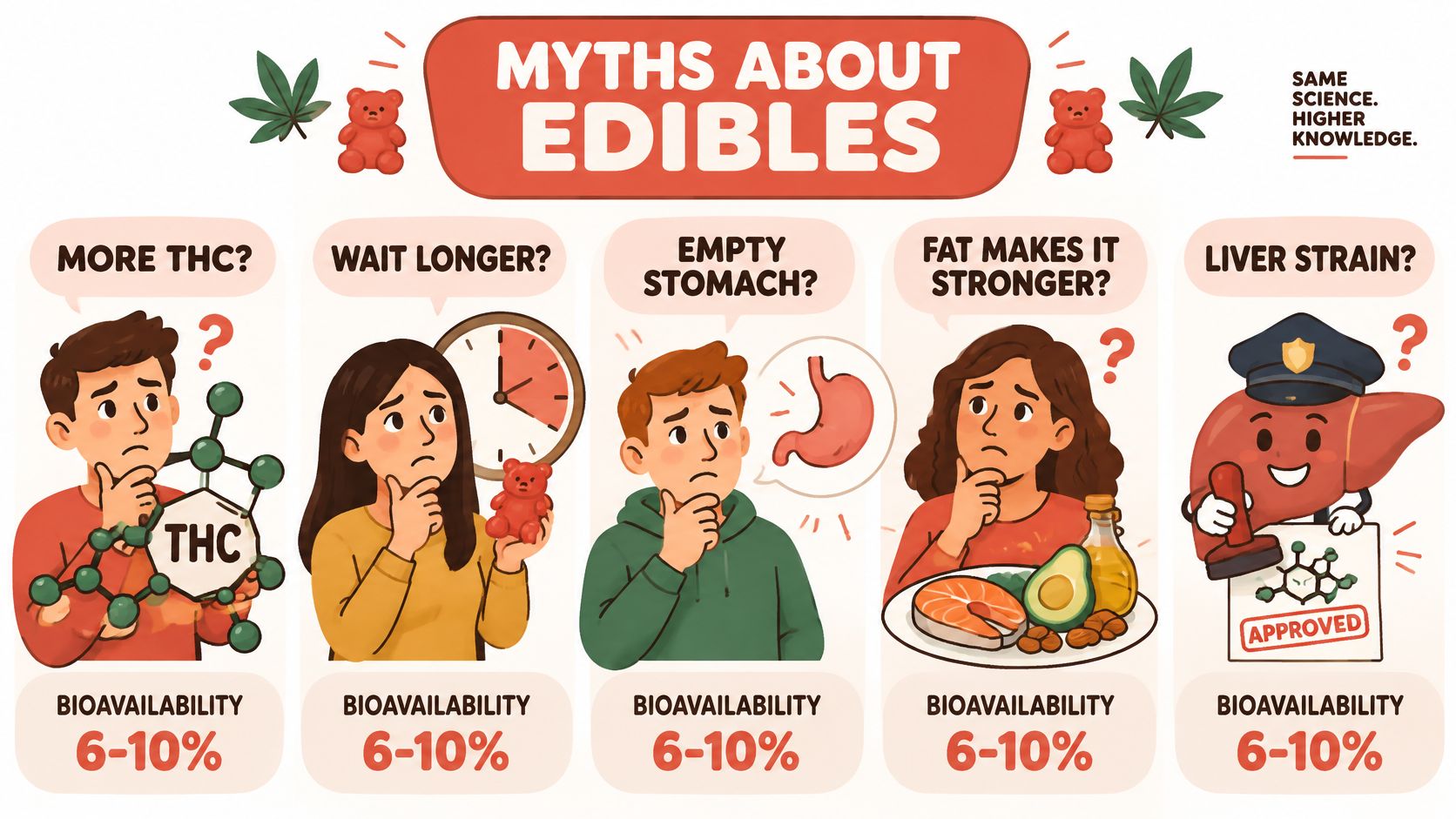
Lower oral bioavailability is a reason for caution, not comfort. Less THC reaching your blood, arriving slowly and partly converted, can outlast and outsurprise a vape every time.
Nine in the evening. You eat a 10 mg gummy and set the bag down. By ten, nothing has happened, so you assume your tolerance is high and take a second piece at half past. The first dose is still moving through your gut. By midnight both doses land within minutes of each other, and you're handling roughly double what you intended while believing you took a normal amount.
The timeline below shows how that evening usually unfolds.
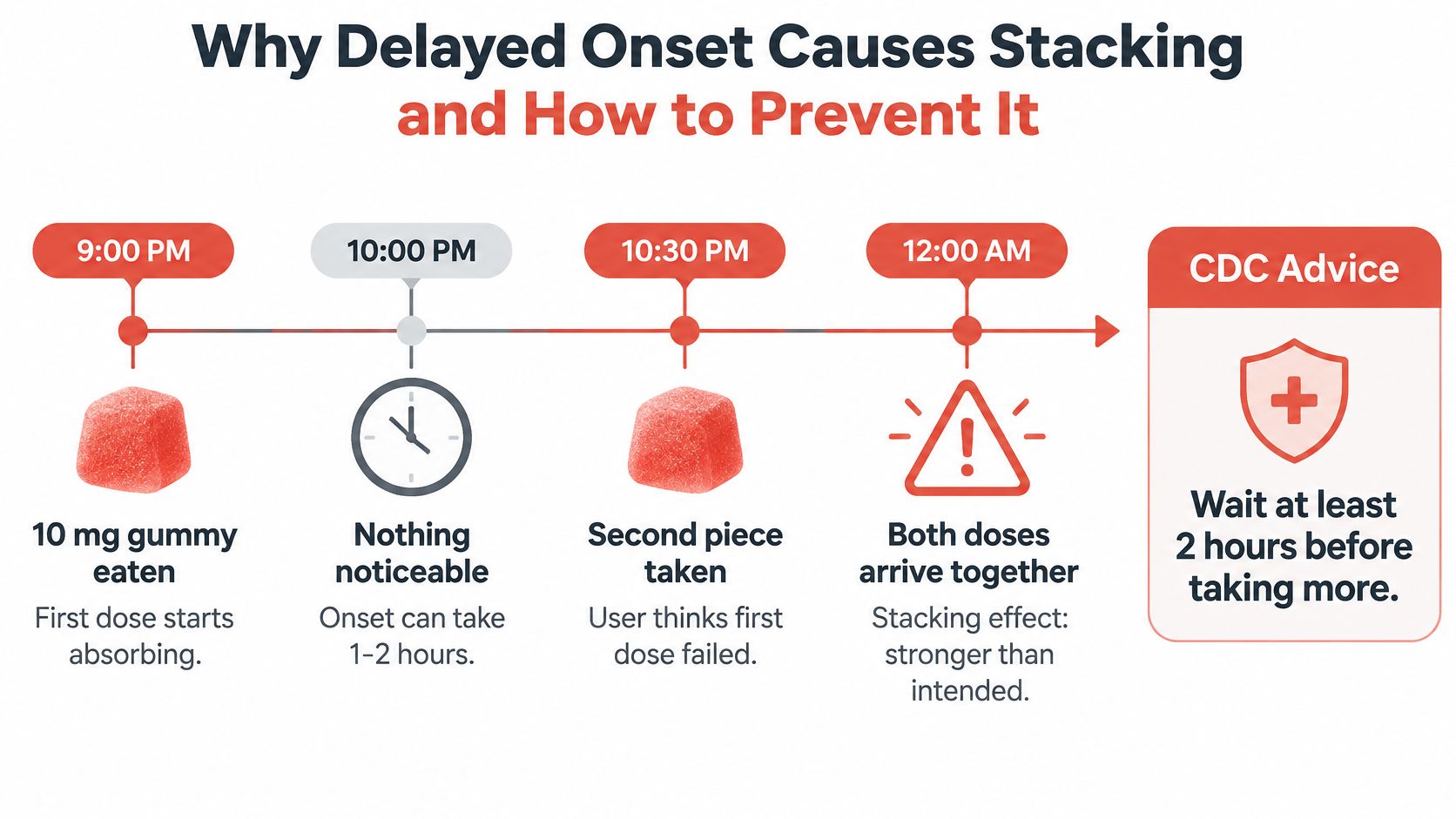
That sequence is the most common route to a bad edible experience, and it's a timing problem rather than a potency problem. The initial dose is still absorbing while the person decides it was ineffective, so intake accumulates before peak effects arrive.
U.S. Centers for Disease Control and Prevention guidance notes that edible effects may take 30 minutes to 2 hours to appear, and that intoxication can last longer than expected depending on dose, food intake, alcohol or medications and individual factors, as America's Poison Centers summarizes. Inhaled cannabis shows its hand within minutes, which is why people who smoke find it easier to stop at the right point.
The consequences show up in tracking data. The same page reports 39,497 cannabis-edible exposure cases among people aged 0 to 19 from 2019 through 2025, including 2,578 recorded by April 30, 2025. Those reports cover unintended exposures and don't represent all adult use, but they show how quickly poorly timed dosing becomes clinically significant.
Your swallowed dose is sitting in a queue. A second piece doesn't jump that queue, it joins it, and both clear the liver at roughly the same time. That's why stacking produces a sharper, higher peak than the same total amount eaten an hour apart would.
Feeling nothing at the sixty minute mark is not evidence that the dose failed. It's the normal shape of the curve. The clock, not your perception, is the better guide.
Wait two hours before you decide a dose was too small. Not ninety minutes because you feel fine, and not an hour because you're bored.
A tested label removes guesswork about what's in the product. It doesn't remove the timing risk, because the timing lives in your gut and your liver, not in the bag.
A 9,973-visit emergency-department analysis found that edible-related visits were less common than inhalation-related visits, but edible users were more likely to arrive with acute psychiatric symptoms such as anxiety or psychosis, cardiovascular symptoms and intoxication. That fits what the pharmacology predicts: a longer exposure window, a metabolite with a long tail, and a dose that's hard to judge while it's still arriving.
Most difficult edible experiences are uncomfortable rather than dangerous. Knowing which is which matters, because sleeping it off is the wrong plan for a small number of situations.
Uncomfortable high or medical emergency, what to do
| Situation | What it looks like | What to do |
|---|---|---|
| Long, uncomfortable high | Conscious, breathing normally, anxious or dizzy but able to respond | Sit or lie somewhere safe, drink water, avoid driving, wait |
| Severe chest pain | Pain in the chest that does not settle | Call emergency services now |
| Fainting or trouble breathing | Loss of consciousness or breathing difficulty | Call emergency services now |
| Extreme confusion or psychosis-like symptoms | Cannot think clearly, severe agitation or hallucinations | Call emergency services now |
| Seizure or inability to stay awake | Convulsions or cannot be woken properly | Call emergency services now |
| Unsure whether it is serious | Symptoms are worrying but not listed above | Contact your local poison-control service for advice |
If you do call for help, give responders the packaging, the amount eaten and the time it was eaten. Those three details tell a clinician more than any description of how high you feel.
If you're too high and want it to ease, our guide on how to bring a high down faster covers what helps and what doesn't. A lab-tested THC number tells you what was in the product. It can't tell you how much 11-hydroxy-THC your liver will make or how long your particular night will run.
If you'd rather not gamble on an unlabeled bag, Melt Bites Zour Belts and Sour Gummy Worms come in 1000 mg bags with lab-tested potency, so you can cut a piece, count the servings and know exactly what you're starting with. Start low, note the time, and give your liver its two hours before you decide anything. Browse the edibles and the rest of the Melt lineup when you're ready to stock up.
Your cart is currently empty.