


Free Shipping All Orders Over $95
You take a draw expecting the flavor printed on the label and get burnt sugar, hot metal and a scratch at the back of your throat. A disposable vape tastes burnt for one underlying reason: the coil is pushing heat into a wick that has run short of liquid. What varies is why the liquid stopped arriving.
Most advice online answers that with chain-vaping or an empty tank, and both are real. They just don't cover the case that frustrates people most, the device that tastes scorched on the first puff, straight out of the wrapper, with a full reservoir and a fresh battery. That's a manufacturing or design failure, and no amount of resting will fix it.
The practical skill is telling those two situations apart before you waste a week retesting a bad unit or throw away a good one.
| Likely cause | How it shows up | Fix to try |
|---|---|---|
| Low liquid reaching the wick | Harsh, scorched taste from the first draw | Stop, then keep the device upright for several minutes |
| Chain-vaping or long draws | Taste builds across back-to-back puffs | Pause about 10 seconds between draws and take shorter puffs |
| Device held below the liquid inlet | Burnt taste when tilted or held sideways | Hold the device upright so liquid can reach the coil |
| Cold or thick liquid | Taste worsens in cold weather or after storage | Warm the device in your hand for a few minutes before use |
| Near-empty reservoir | Burnt taste late in the device life | Stop using it, because the wick is likely spent |
| Restricted airflow | Tight draw with hot, harsh vapor | Check the airflow inlet for lint or debris and draw more gently |
| Manufacturing defect | Burnt taste from the very first puff on a new device | Stop using it and return or report it to the seller |
Most burnt hits land in the first five rows, and most of those settle once liquid reaches the coil and the wick gets a few minutes of rest. The bottom two rows are different: those are the cases where more testing just burns more cotton.
The complaint is common enough to appear in population-level vaping research. In the six-country EUREST-PLUS ITC Europe survey, 14 of 110 current e-cigarette users (12.7%) reported a "dry puff or burnt taste" during the previous six months, according to the peer-reviewed analysis of the survey.
The same analysis tied the experience to how people operate their devices rather than to what they put in them. Users who occasionally or regularly adjusted voltage, power or temperature had 6.01 times the odds of ever experiencing a dry puff (95% confidence interval 2.68 to 13.46). Power outrunning liquid supply is the whole mechanism in one number.
Two other faults the survey recorded are easy to conflate with this one: battery overheating in 12 of 109 respondents (11.0%) and product breakage in 9 of 110 (8.2%). Both deserve attention on their own terms, but neither explains a burnt taste.
Start with the row that matches when your device turns burnt, and if none of them fit, the useful next question is whether you're fighting a habit or a faulty unit.
Disposables now carry flavors built to be loud: candied fruit, custard, tobacco with a caramel finish. Some of them read as toasty on the way out, and a scorched wick can taste almost flavorless once the cotton has carbonised. Run this check before you start troubleshooting, so you don't rebuild your habits around a flavor that's doing its job.
Flavor alone can't prove cause. A dense, creamy oil can read as scorched when nothing is wrong, and a scorched wick stops tasting of the flavor at all after a while. That's why the timing of the taste tells you more than its strength.
Flavor strength tells you almost nothing. When the taste appears tells you nearly everything.
Terpene-forward formulations blur the line further, and our breakdown of cannabis-flavored vape profiles covers how much of that character comes from the formulation rather than the hardware.
Two minutes of restraint saves the rest of the device's life in the cases where the wick is only dry, not damaged. Once cotton is scorched it stays scorched, so the goal is to stop before that line gets crossed.
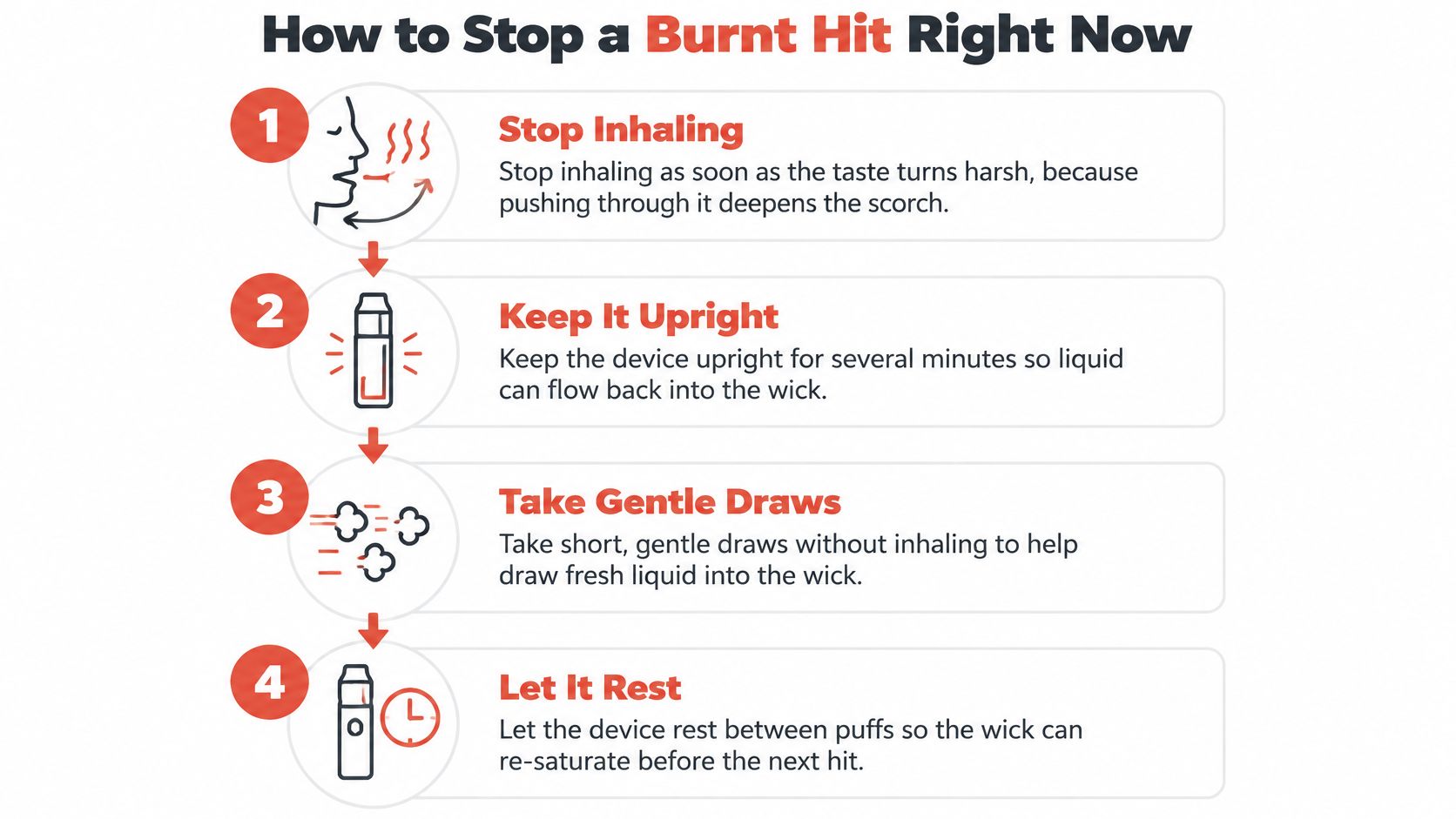
If you'd rather watch the sequence than read it, this walkthrough covers the same ground.
What normal looks like: clean flavor on the first draw, steady vapor on every draw after it, and no scratch or bitterness once you exhale. Anything short of that is the device telling you something.
A sealed disposable can look full and still taste scorched on the first pull. The visible liquid only tells you the reservoir has something in it. The heater can only vaporise what the wick delivers, so a badly balanced device can outrun its wick from the start. That is why a fresh pod can taste burnt while a half-used one handled carefully tastes clean. The failure point is where liquid meets heat, and the basic mechanics are covered in this guide to how vape pens work.
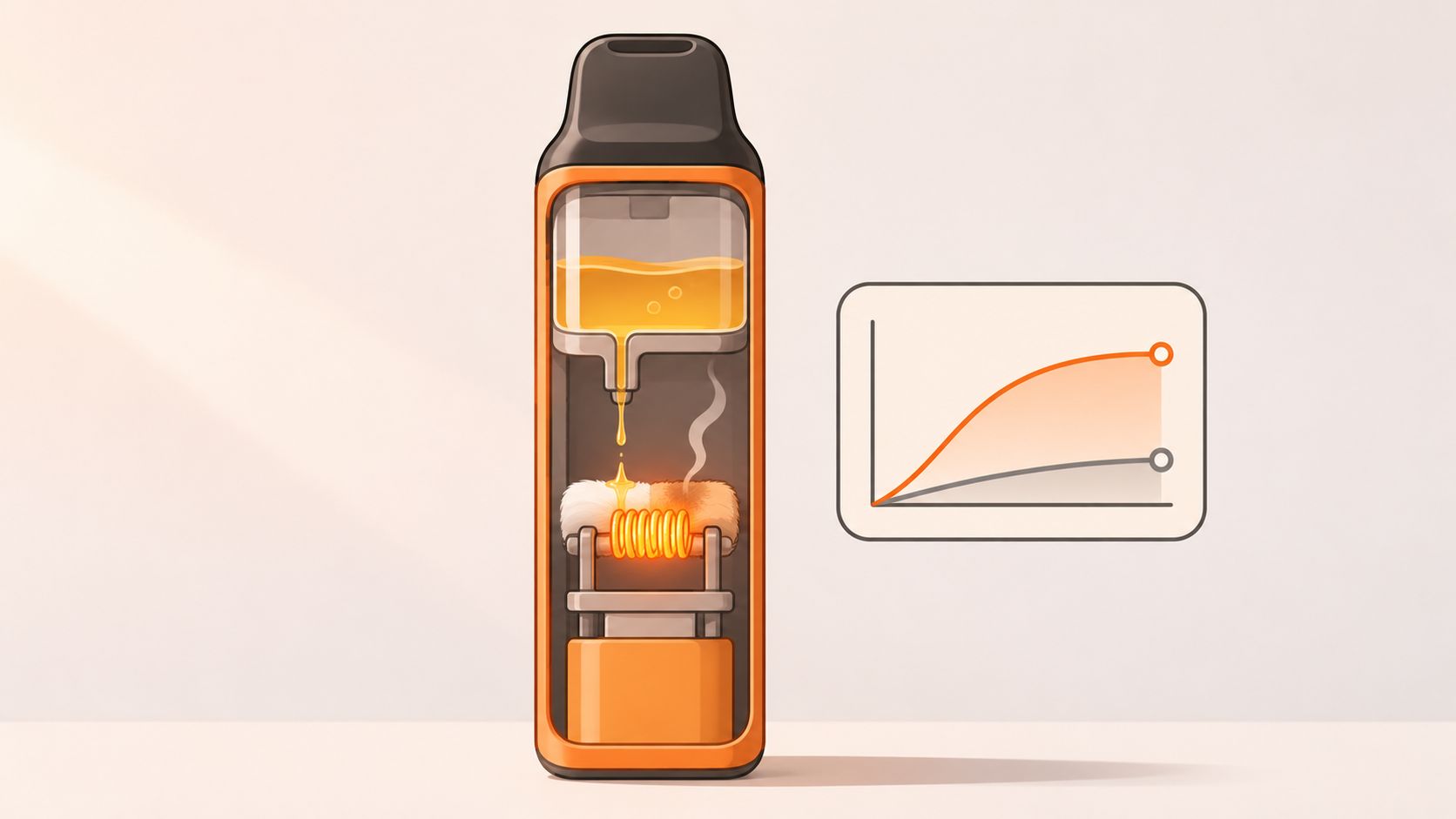
A burnt flavor is what a dry puff tastes like, and the term is descriptive rather than vague: the coil receives too little e-liquid, or the device applies more power than a saturated wick can support. In a 2021 laboratory study that matched sensory ratings against aerosol chemistry, 13 experienced e-cigarette users assessed devices running from 10 to 25 watts on 1.2-ohm and 1.6-ohm coils with menthol, vanilla and fruit liquids. The laboratory classification agreed with the human assessment for 83% of 108 tested puffs, with a 17% false-negative rate and no false positives. Your tongue is a decent instrument and an imperfect one.
Coil temperature explains the suddenness. Under dry conditions, peak coil temperatures ranged from 322°C to 1,008°C, against 145°C to 334°C when the wick stayed wet through.
| Condition | Peak coil temperature |
|---|---|
| Dry, wick depleted | 322°C to 1,008°C |
| Wet through wick | 145°C to 334°C |
The practical split matters. Chain-vaping and an empty tank are user problems, but a burnt first puff from a newly opened device points to wick saturation, coil alignment, airflow or calibration. The trade-off is simple: one careful pause can test whether the wick recovers, but repeated pulls on a scorching first draw waste the pod.
A burnt hit isn't a flavor problem you can season your way out of. It's a thermal event: the wick is under-saturated, the coil overheats what little liquid remains, and the wick and aerosol ingredients begin to break down. That's the framework set out in the dry-puff emissions record in the EPA's HERO database, and the emissions data attached to it is why the taste deserves a stop signal rather than a shrug.
In laboratory testing, aldehyde emissions under dry-puff conditions rose approximately 30 to 250 times compared with normal conditions. Reported maxima per 10 puffs reached 344.6 µg formaldehyde, 206.3 µg acetaldehyde and 210.4 µg acrolein.
Those are bench emissions from a controlled setup, not a measurement of your intake, which depends on the device, the puff and how long you keep going. The conclusion doesn't need the dose to be exact. Once the wick is degrading, you're no longer drawing heated flavoring, and every extra hit moves the exposure in the wrong direction.
The common workarounds make it worse. Cranking up a stronger flavor, adding a cooling agent, or drawing harder to "clear" the coil all keep a scorched wick in service. A disposable is a closed system: you can't rewick it, and you can't wash carbon off cotton that's already burnt.
My rule: one rest period is a fair test. A second one is procrastination.
Stop vaping and get medical advice if any of those show up, particularly the last two. Otherwise the verdict is simple. If the burnt flavor survives the rest, the lower power and the gentler draws, the device is finished. Retire it.
Read the pattern by timing, not intensity. When the taste arrives tells you which fault you're dealing with, and the right response follows from there.
| Situation | What it likely means | What to do |
|---|---|---|
| Burnt on the first puff | Likely defect or a heavy first draw | Stop, do not repeat tests, and note the batch |
| Burnt only after rapid repeated draws | Heater outrunning the wick | Rest the device upright for several minutes, then take shorter draws |
| Clears after rest and gentler draws | Temporary dry-out | Continue with slower, shorter draws and watch the flavor |
| Returns after rest | Wick or coil damage | Discard the device and do not refill it |
| Returns on a new device | Manufacturing or calibration defect | Return or replace it and report the batch to the seller |
If you're sending one back, gather the batch or lot number from the packaging, the purchase date and order number, and a photo of the device and its box. Batch records are how a seller traces a bad run. They're also the only feedback loop that reaches the people who can fix a drifting heater calibration, and published reviews of disposable device quality control make the case that device-level checks such as draw resistance, heater output, leak rate and failure rates by batch are exactly what buyers currently can't see.
Prevention comes down to a few habits that keep the wick wet:
The one rule worth remembering: if a burnt taste comes back after a proper rest, the device is done. Don't refill it, don't keep pulling to clear it, and don't buy that batch again.
A device that clears after one rest and stays clean is worth keeping. Anything else is a return, not a project.
A disposable should taste like the oil inside it, not like the coil overheating it. Melt builds all-in-one devices and strain-specific THCA flower in Los Angeles, with third-party testing and published lab reports behind each batch, so a burnt hit is a fault you can trace and report rather than something you have to live with. Visit Melt to see the current lineup of disposables, flower and prerolls.
Your cart is currently empty.