


Free Shipping All Orders Over $95
For most adults, a 5 mg THC edible is a low-to-moderate dose, about double the 2.5 mg Health Canada suggests for beginners, and its effects typically peak 2 to 4 hours after eating. The number on the package is a measurement of THC, not a forecast of how the next four hours will go.
Which raises the question almost nobody asks before their first gummy: why do so many people judge the dose at the 45-minute mark, when the edible hasn't finished arriving? Most of the confusion around how strong a 5 mg edible feels comes from watching the wrong clock. People check in too early, decide nothing is happening, and then meet the full dose all at once on top of a second one.
Five milligrams is a quantity, not a sensation. It tells you what was formulated into the product. It doesn't tell you what your liver will do with it, what you ate beforehand, or what your tolerance looks like this week. Once you separate those two ideas, dosing stops being a guessing game and becomes a schedule you can follow.
As a starting serving for adults, 5 mg of THC sits in the low-to-moderate range. Health Canada's guidance for people who choose to consume cannabis describes it as roughly double the 2.5 mg or less the agency points new consumers toward, while keeping it inside the 2.5 to 10 mg band where people are advised to exercise caution. That's the honest frame: not tiny, not heavy, but the middle of a range you're meant to move through slowly.
What you notice at that level depends mostly on your history with THC.
| User | Typical effect at 5 mg | Suggested handling |
|---|---|---|
| New or infrequent user | Noticeable euphoria, relaxation, altered time perception, possible drowsiness | Treat as a full trial dose and wait before any more |
| Occasional user | Clearly perceptible and possibly impairing | Use only in a safe setting and do not drive |
| Frequent user | Mild, often barely noticeable effect | Still wait the full effect window before redosing |
| Adults over 55 or on interacting medications | Stronger effects likely | Health Canada suggests starting at 1.25 mg THC |
That last row isn't a formality. Health Canada's medical-use guidance starts adults at 2.5 mg THC once daily and drops to 1.25 mg for people over 55 or those with relevant health conditions or interacting medications, which places 5 mg at twice the general introductory dose, according to the federal composition requirements for cannabis products.
For an occasional user, 5 mg is perceptible and potentially impairing. For a frequent user, the same serving may register as barely anything. Neither person is wrong, and neither response predicts yours.
The useful takeaway: the first 5 mg you take is a full trial dose, not a warm-up you're expected to build past.
Treat the label as a starting coordinate. Your own tolerance, not the packaging, decides what 5 mg feels like.
A 5 mg edible runs on a delayed clock, and the delay is exactly where people misread it. Take one gummy at 7 pm. By 7:40 there's a faint looseness in your shoulders, nothing more. At 8:15 you're still waiting and mildly annoyed. By 9:30 the room has gone warm and elastic, and you understand why people warn you about edibles.
That curve is what an ordinary 5 mg edible does.
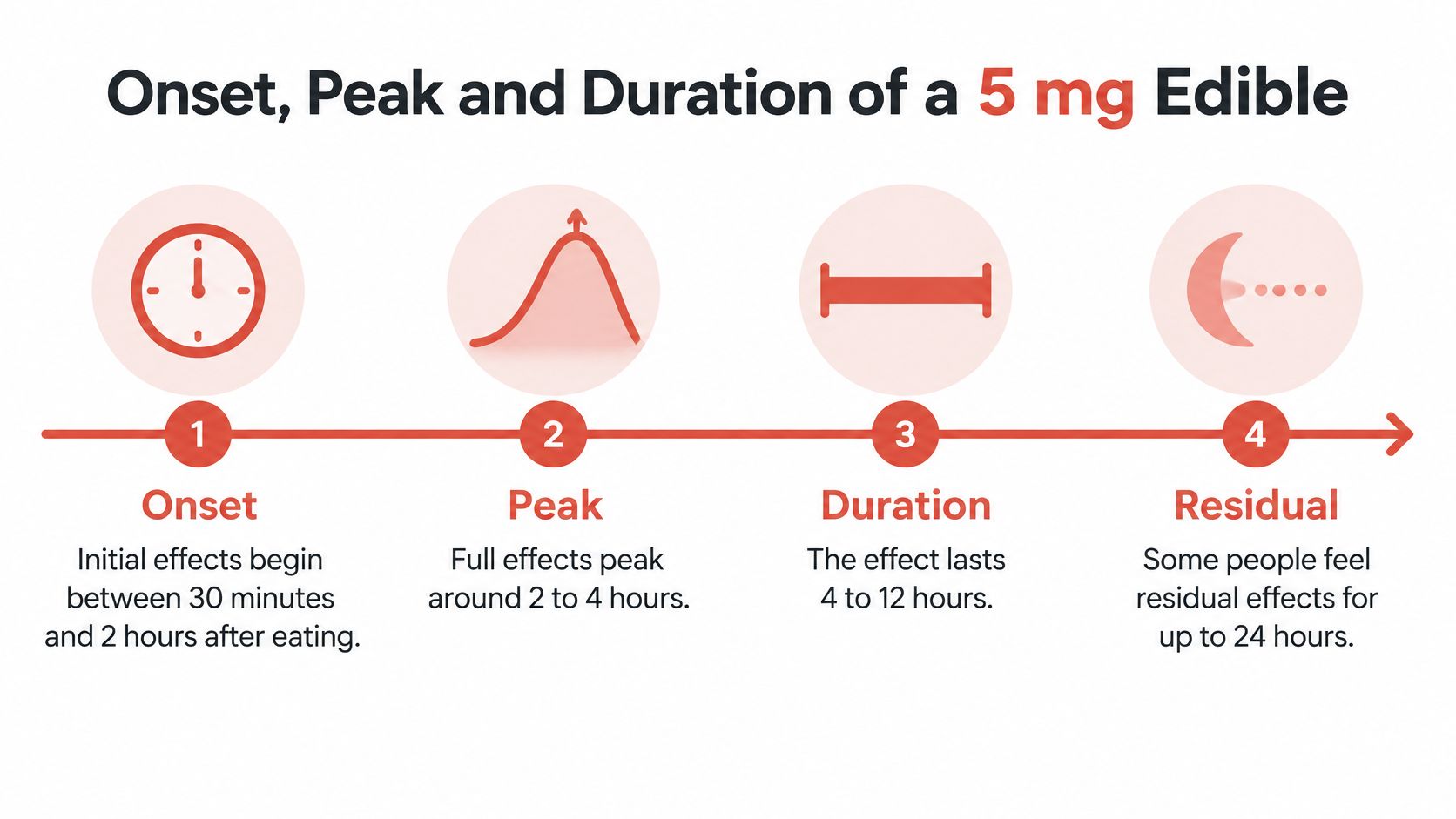
The first hour is only the start of the curve, and the peak sits well past it. Government guidance generally places initial effects between 30 minutes and 2 hours, with full effects arriving roughly 2 to 4 hours after you eat, as Ontario's guidance on the health effects of cannabis edibles sets out. The same page notes that Washington State describes ingested cannabis as slower to start, roughly 1 to 4 hours, and lasting 4 to 12 hours, compared with inhaled cannabis, which begins almost immediately to 10 minutes and typically runs 1 to 3 hours. Public-health guidance elsewhere echoes the same shape: a slow build, a late peak, and a long taper rather than the quick arc of smoking.
| Phase | Typical window | What it feels like |
|---|---|---|
| Onset | 30 minutes to 2 hours | Mild relaxation, or nothing yet |
| Peak | 2 to 4 hours | Full euphoria, altered perception, reduced attention |
| Full duration | 4 to 12 hours | Gradual fade, drowsiness possible |
| Lingering effects | Up to 24 hours in some cases | Residual impairment, do not drive |
THC that goes through your digestive tract reaches the liver before it reaches your brain, and liver enzymes convert part of it into 11-hydroxy-THC, an active metabolite that produces stronger and longer-lasting effects than the THC you swallowed. Inhaled THC skips that conversion almost entirely, which is why a joint and a gummy of the same milligram count don't share a timeline.
A match and a log is the closest comparison. A match flares bright and dies down. A log takes a while to catch, then burns steadily for hours. You can put out a match by waiting. You can't rush a log by throwing another one on.
Here's how the typical bad night happens. At the one-hour mark, nothing has happened, so a second piece seems reasonable. Both doses then finish digesting at roughly the same time and peak together. The edible itself was ordinary. Two standard servings had arrived as a pair.
The redose test: reaching for a second piece because you feel nothing yet is the clearest signal to keep waiting.
Give one serving a full four hours before you judge it, since that window covers the entire expected peak. Impairment can also outlast the noticeable high, so feeling the effects fade is no proof your reaction time is back to baseline. Plan the drive for the next day, not for the moment the peak passes. If you want the fuller breakdown of edible timing before you plan a session, read how long edibles take to kick in.
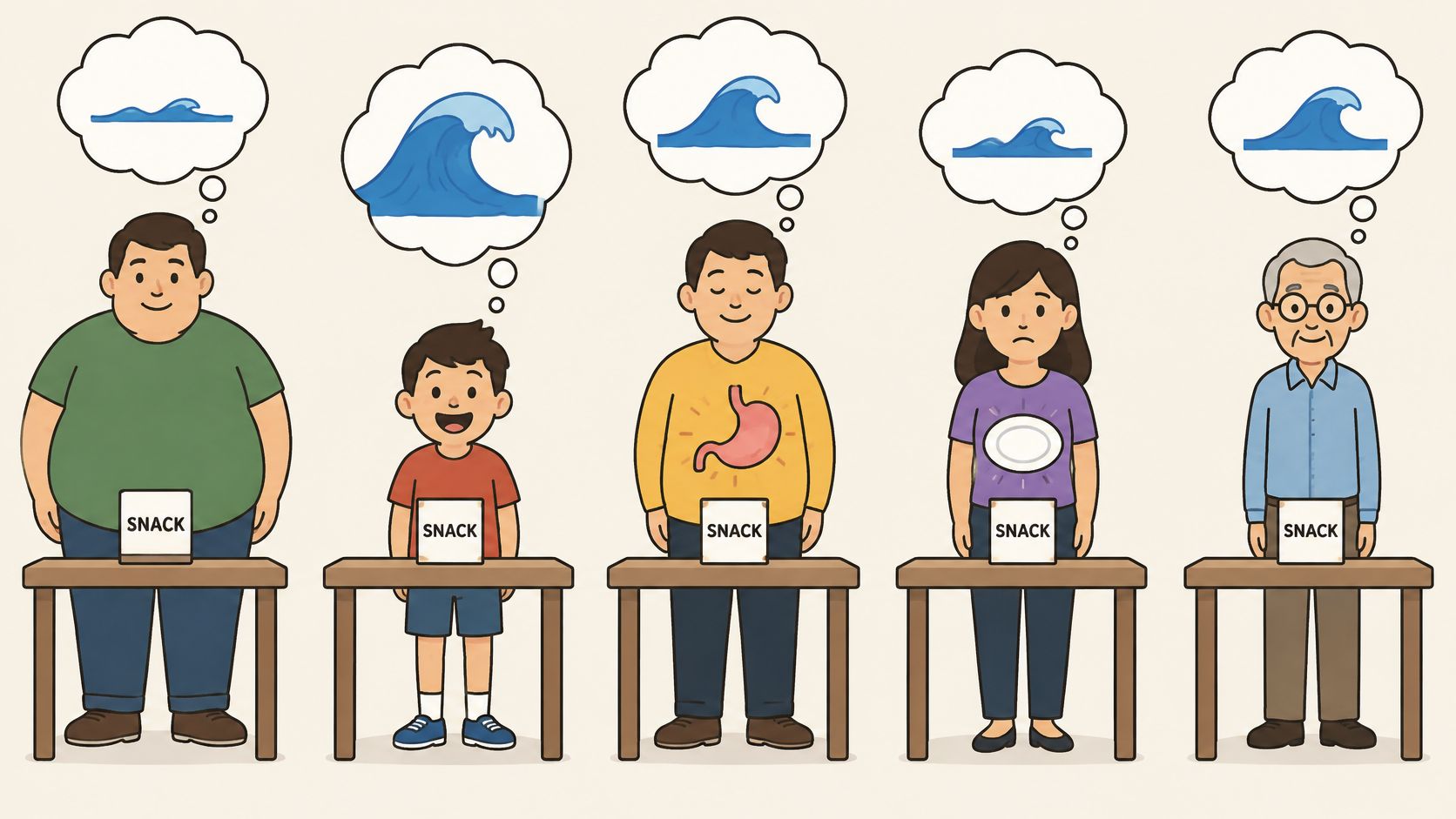
Two people split the same bag of gummies and have completely different evenings. The milligram was identical. Everything else wasn't.
These factors move the needle, roughly in order of influence:
Maryland's public-health guidance lists 2.5 to 5 mg THC as a starting serving for edibles and is blunt that the figure is a labeled quantity rather than a guaranteed subjective strength, as the state's Be Cannabis Smart guide explains. The same guidance notes that Health Canada considers standardized, precise cannabis dosages not yet established and recommends dose titration, starting low and increasing gradually only when needed, because side effects become more likely as the THC dose rises.
That logic is worth sitting with. If the professionals can't yet promise that a milligram will produce a fixed effect, you shouldn't expect your body to either.
Keep a short note on your phone after your first few servings: the time you took it, what you ate beforehand, and how you felt at the two-hour and four-hour marks. Three entries will tell you more about your own dose than any chart, including this one.
Here's the part that unsettles people. A peer-reviewed analysis of 75 edible products published in JAMA found that only 17% were accurately labeled, while 23% contained less THC than stated and 60% contained more. A "5 mg edible" can therefore behave like a 3 mg dose or an 8 mg dose depending on how carefully it was made.
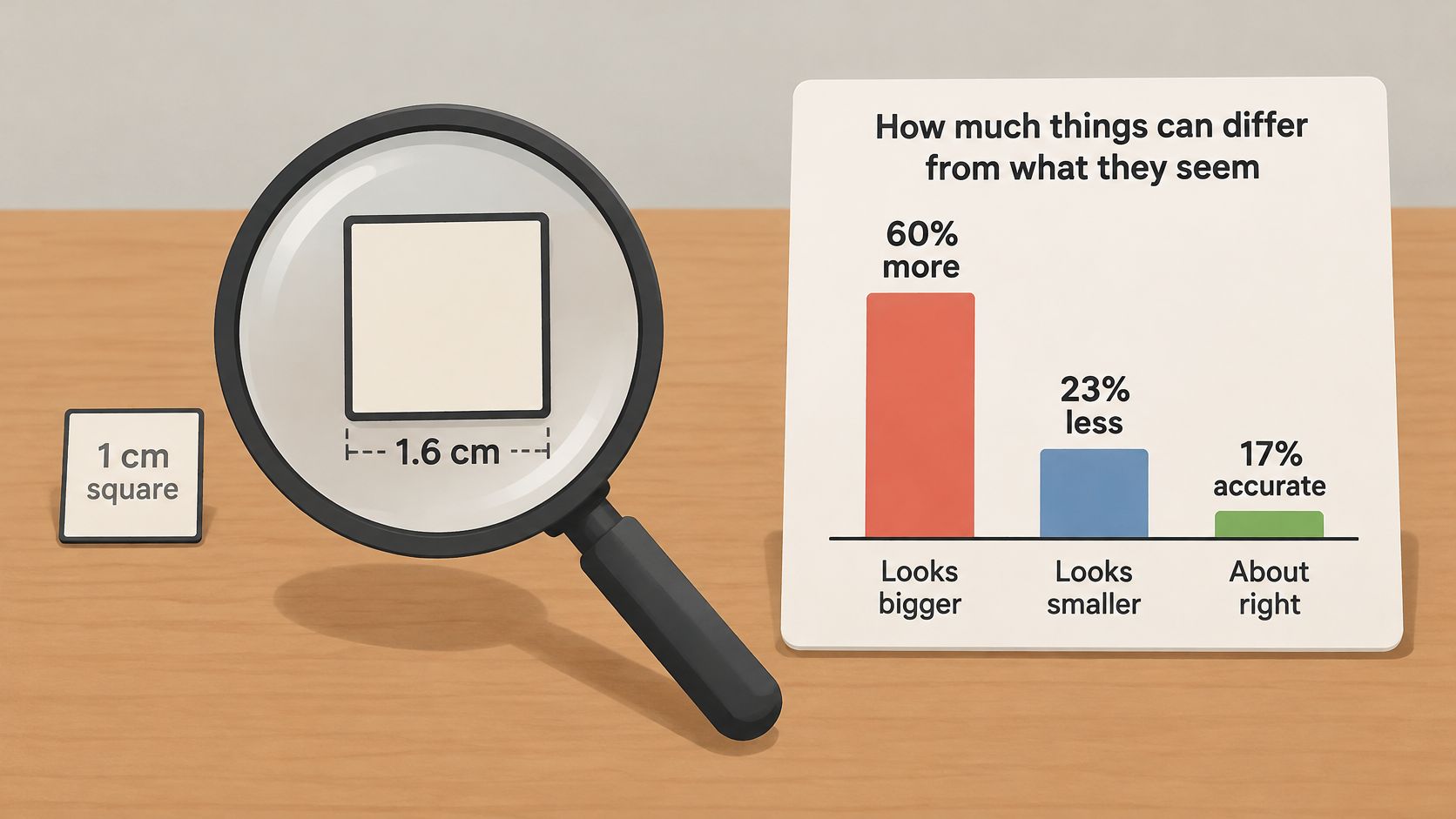
That analysis is older and doesn't establish accuracy across every regulated market today. What it does establish is a habit worth keeping: treat the printed number as a claim to verify, not a fact to trust.
A gummy isn't a homogeneous material. Cannabinoids can distribute unevenly through a batch, so one piece may carry noticeably more than its neighbour. That's why cutting a 10 mg gummy into halves gives you a theoretical 5 mg, not a guaranteed one.
Every product we sell at Melt, from flower and prerolls to edibles, is lab-tested, and the certificate of analysis is the document that turns a label into something you can check. If the abbreviations and columns look like noise, this walkthrough on how to read a certificate of analysis breaks down which figures matter for dosing.
A compliant label is a claim about a batch. It's never a promise about your evening.
A small number on a package doesn't make an edible low risk. The things that turn 5 mg into a difficult night are almost never about the milligram itself. They come down to timing, setting and what else is already in your system.
The five recurring mistakes:
The knowledge gap behind these mistakes is wider than most consumers assume. In the Canadian Cannabis Survey 2024 summary, only 51% of respondents correctly identified that edible cannabis products can take 4 or more hours to produce their full effects. That figure explains why the quiet early stretch of an edible is the riskiest part of the evening: the full serving is still on its way, and nothing you feel yet is the whole story.
Stay where you are and get comfortable. Sit or lie down, drink water, put your phone away and stop adding THC, caffeine or alcohol to the situation. The discomfort is time-limited, and the most useful thing you can do is remove stimulation and let the window close. Seek medical help for severe panic, repeated vomiting or trouble breathing, and don't drive yourself.
A line worth remembering: a bad edible hour feels permanent and isn't. Nothing you do makes it pass faster except waiting it out calmly.
If you want the step-by-step version of everything above in one place, this guide to how to dose edibles walks through serving math and timing together.
Five milligrams is a moderate trial dose that rewards patience. Take it once, wait out the full window, and let the answer come to you instead of chasing it with a second piece.
If you'd rather start from a product whose potency you can verify before the first bite, Melt lab-tests flower, prerolls and edibles so the number on the package traces back to a batch report you can read. Our Melt Bites sour THC gummies come in 1000 mg bags, including Watermelon Sour and Sour Gummy Worms THC Crawlers, which means you can work out the serving math for yourself before you commit. Visit Melt to browse the edibles lineup and check the lab reports behind each one.
Your cart is currently empty.