


Free Shipping All Orders Over $95
Why should someone who eats a small gummy at bedtime follow the same tolerance-break schedule as someone who uses high-potency cannabis throughout the day? They shouldn't automatically, yet much of the advice about an edible tolerance break treats those patterns as interchangeable.
A break is a temporary pause from cannabis intended to reduce tolerance, not a guaranteed reset on a fixed deadline. The useful questions are what you're taking, how often you're taking it, what you want to change, and whether stopping brings symptoms that need support.
| Use pattern | Break length | What it tests | Withdrawal expectation | Restart guidance |
|---|---|---|---|---|
| Occasional use, less than weekly | A short pause, such as 48 to 72 hours, or about a week, is a planning option, not a proven prescription | Your baseline experience without cannabis and whether dosing has become automatic | Don't assume withdrawal; the established timing comes mainly from frequent, long-term users | Restart below your previous dose and compare effects over several sessions |
| Nightly low-dose use, 2.5 to 10 mg | About two weeks or longer can be a practical observation period, not a validated low-dose protocol | Whether sleep, mood, and perceived effects change without the nightly dose | This group hasn't been directly studied for withdrawal; sleep changes deserve particular attention | Restart low, keep conditions consistent, and monitor sleep and mood |
| Daily high-dose use | About four weeks, with clinical input | A period aligned with the strongest human imaging evidence for substantial receptor recovery | Withdrawal may be prolonged or disruptive; arrange help rather than simply enduring severe symptoms | Restart at a substantially lower dose and reassess before increasing |
These are planning options, not tested prescriptions for each edible-use group. The clinical review of cannabis withdrawal describes short pauses of 48–72 hours, improvement toward baseline within 1–3 weeks for many withdrawal symptoms, and receptor availability comparable with controls after about one month. Those findings support different goals for different break lengths, but they don't establish a personalized timer.
For an occasional consumer, a pause may be more useful for noticing habits than for pursuing major receptor recovery. Say you reach for a gummy whenever you watch a movie, even when you hadn't planned to use cannabis. Taking that ritual out of the evening helps you distinguish wanting the experience from repeating it.
Nightly low-dose use needs more caution in interpretation. The ACOEM cannabis guideline highlights the limits of applying broader cannabis findings to oral products, including the unanswered question of withdrawal in people taking a nightly 2.5–10 mg edible. An observation period for this group is an experiment, not proof that a particular duration restores sensitivity.
For daily high-dose use, plan around both tolerance and the practical demands of stopping. If cannabis has become central to sleeping, eating, or getting through the day, clinical input can help you prepare for symptoms and address the reason you were using it.
Choose a purpose before choosing a deadline: Interrupting a habit, observing sleep without cannabis, and allowing substantial receptor recovery are different goals.
A brief break can reveal how strongly cannabis structures your routine. It can also end while your body is still adjusting, which makes the first uncomfortable night a poor measure of whether the break is useful.
The table's withdrawal guidance is deliberately cautious. Symptoms observed in frequent, long-term users shouldn't be assigned automatically to someone who occasionally eats a gummy, and the absence of symptoms doesn't establish that tolerance has disappeared.
Every row ends with the same safety principle: don't return automatically to your previous amount. Your next dose should test what you need now, not recreate what you could tolerate before.
Say your usual gummy gradually feels less noticeable, so you begin taking more. One explanation is tolerance, an adaptation in which the same amount produces less effect, rather than evidence that your product has stopped working.
A doorbell offers a simple analogy: repeated use leaves the system less responsive, so you feel tempted to press more often to get the same response.
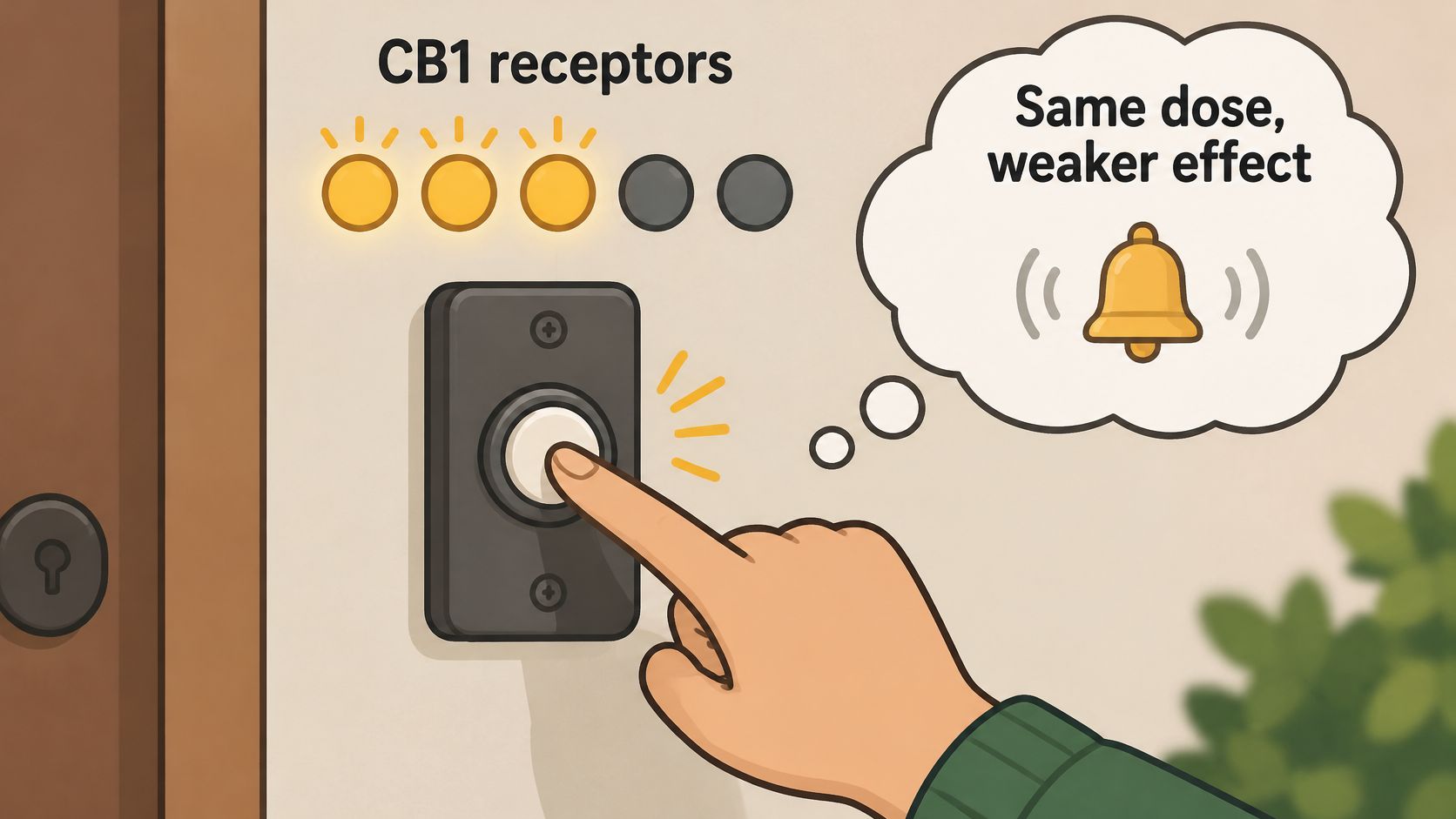
THC acts through CB1 receptors, part of the body's endocannabinoid signaling system. With chronic exposure, fewer receptors may be available, helping explain why a familiar amount becomes less effective; our explanation of the endocannabinoid system introduces the wider system in plain language.
A review of human cannabinoid-receptor imaging describes a monitored study of cannabis-dependent men in which group differences in CB1 receptor availability were no longer detectable after two days of abstinence. That finding supports the possibility of early recovery, but it doesn't show that an edible will feel a certain amount stronger after a short break.
The distinction between biology and experience matters. These studies examined chronic cannabis users and receptor availability, not a predictable change in the subjective strength of a bedtime gummy.
This video offers another way to approach the topic.
An edible tolerance break isn't just a process of flushing THC out. A review of cannabinoid pharmacokinetics describes relatively limited pharmacokinetic changes during chronic oral administration, with behavioral and physiological tolerance attributed mainly to adaptation rather than dramatically faster clearance.
Oral THC also takes a different route through the body: metabolism produces 11-hydroxy-THC, and delayed effects can tempt someone to take another serving before the first has fully developed. That repeated dosing can make it difficult to recognize how much was needed.
A lower response to a familiar dose doesn't mean your body simply eliminates THC faster.
After abstinence, the old amount may feel unexpectedly strong. Receptor recovery is a reason to be conservative when restarting, not a reason to test your previous maximum.
The National Institute on Drug Abuse cites an estimate that 12.1% of people who frequently use cannabis experience withdrawal; clinical descriptions place onset at 24–48 hours, the typical peak between days 2 and 6, and possible duration at three weeks or longer in heavy users. Those are broad patterns, not a promise about what will happen to you.
The clinical timeline works like a regional weather forecast: it tells you the season, not the hour the rain reaches your street. Those numbers also come largely from people who used cannabis frequently and heavily. If your pattern is a single low-dose edible each night, that group hasn't been studied as its own case, so your experience may be milder, shorter, or different from the published ranges.
Withdrawal isn't inevitable, and a break shouldn't be described as universally effortless. Knowing what might happen helps you prepare without treating every uncomfortable feeling as evidence that something is wrong.
The timeline below is an overview, not a deadline by which every symptom must disappear.
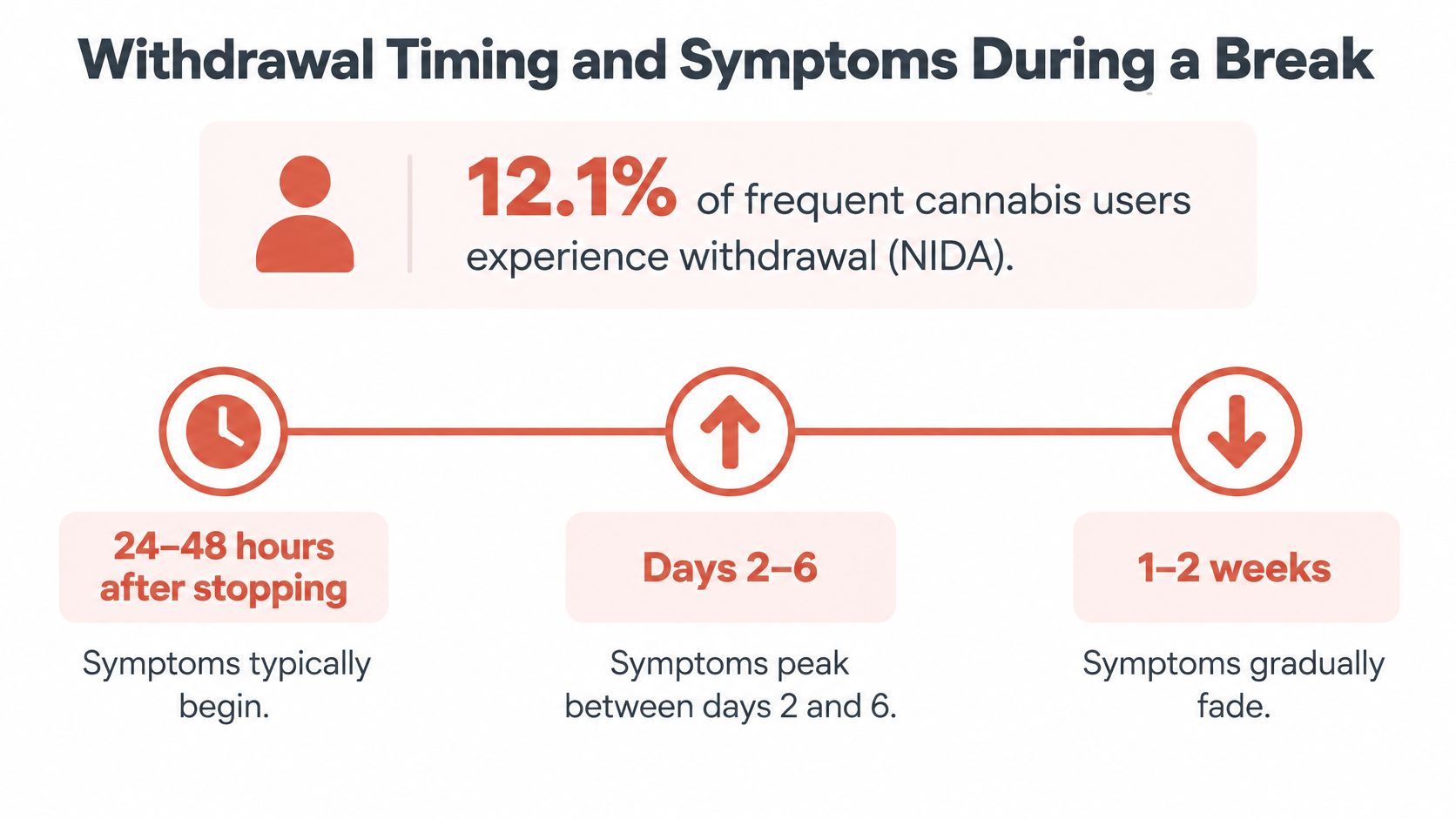
Symptoms can affect both mood and the body. You don't need to experience the entire list for stopping cannabis to be affecting you.
Vivid dreams tend to catch people off guard, especially when the edible was part of a sleep routine. A rough night after stopping can feel like something has gone wrong; often it is just your sleep adjusting to the change.
Keep a simple record of what's happening and whether it's improving, worsening, or interfering with basic activities. A note such as slept poorly but ate breakfast and worked normally is more useful than labeling the whole day a failure.
Keep familiar meal times, fluids available, and a regular sleep schedule. Choose easy meals if your appetite is low, and replace the usual edible ritual with a specific activity, such as an evening walk or preparing tomorrow's lunch.
Avoid deciding in the middle of a restless night that an edible must be your rescue. If symptoms are difficult to manage, discuss support with a clinician rather than repeatedly switching between abstinence and unplanned dosing.
Because stopping is uncomfortable, it is tempting to assume the discomfort proves the break is accomplishing something on its own. Taking a break doesn't automatically improve control over future use. The practical question is whether your discomfort is manageable and settling, or whether you need help. Treat changes in functioning as important information, not a test of willpower.
A stronger experience after abstinence can suggest reduced tolerance, but a different experience doesn't always come from the break itself. Changing the product, meal, setting, and dose together makes it hard to identify what mattered.
Think of your restart as a comparison you want to interpret. Keep the parts you can control reasonably consistent, and acknowledge the parts you can't.
| Variable | Concrete example | What to do with it |
|---|---|---|
| Product potency | A belt and a gummy may contain very different amounts per piece | Read the serving information instead of treating a piece as a standard dose |
| Amount consumed | A larger bite can mean more THC even when the product is unchanged | Record the labeled amount taken, not just the number of pieces |
| Meal composition and timing | Taking an edible after dinner isn't the same setup as taking it without food | Use a familiar, similar meal when comparing experiences |
| Metabolism | Your partner's response may differ from yours despite using the same product | Use your own response rather than borrowing another person's dose |
| Body size | Two people of similar weight can still respond differently | Don't use body weight as a reliable tolerance calculator |
| Time and setting | A quiet evening can feel different from a stressful afternoon | Note the setting and what you were trying to achieve |
| Frequency | Adding daytime doses changes a previously bedtime-only pattern | Count all cannabis use, not only the edible you consider your usual dose |
Food can change how and when oral THC is absorbed, which is one reason a familiar product may feel inconsistent. Our guide to why edibles can hit harder explains the practical differences between eating cannabis and inhaling it.
The evidence is stronger for frequent cannabis use, particularly inhaled use, than for ordinary edible-only patterns. Direct evidence about withdrawal in nightly low-dose consumers is missing, so it remains unclear whether a short pause meaningfully changes tolerance, mainly disrupts sleep, or does something different for different people.
That uncertainty should change how you judge the result. A disappointing restart doesn't establish that you need more THC, and a restless break doesn't prove you require cannabis indefinitely.
Tolerance may also be specific to the effect you notice. Someone might perceive less intoxication while still noticing an effect on sleep, making a single rating such as worked or didn't work too crude.
Record the outcome you actually care about, such as sleep quality or next-morning grogginess, rather than measuring success only by how high you feel.
A fixed week off isn't a universal answer. The clinical discussion of cannabis withdrawal and problematic use explains why a one-week break may be adequate for some occasional users yet overlap with the most difficult early period for daily users.
Discomfort after stopping doesn't automatically mean addiction. Clinicians consider craving, impaired control, increasing time spent using, and interference with daily life, not tolerance alone.
A calendar can help organize a break, but it can't determine whether you're safe. The intensity of symptoms and your ability to manage ordinary responsibilities matter more than completing a streak.
If you use cannabis for pain, insomnia, anxiety, or PTSD symptoms, stopping may remove a coping tool without replacing it. A rapid return to use may reflect an untreated condition, withdrawal, or both.
Tell your clinician what you were using, what you hoped it would treat, and what changed when you stopped. A useful treatment conversation includes the original symptoms as well as cannabis use, rather than assuming that abstinence alone will resolve everything.
You can also ask for help before a break becomes overwhelming. Repeatedly planning to stop, using more than intended, or returning despite meaningful harm are reasons to discuss your pattern openly.
A tolerance break is neither an addiction diagnosis nor a substitute for care. It can provide information, but you don't have to interpret difficult symptoms alone.
Before stopping, open a note on your phone and record the product, labeled dose, frequency, and reason you take it. Include other cannabis use, because pausing gummies while continuing to vape doesn't create a cannabis-abstinence break.
Choose a provisional end date based on your pattern and purpose. If cannabis is part of prescribed treatment, discuss the plan with your clinician before changing it.
Write down your intended restart amount while you're clear-headed. Choose substantially less than your pre-break amount, and select a product whose labeling lets you measure that amount reliably.
Don't assume a high-potency gummy can be divided accurately into tiny doses. If the serving size makes careful measurement impractical, choose a more manageable product rather than estimating a small corner by eye.
This visual summarizes the planning sequence; its example dose isn't a personalized prescription.
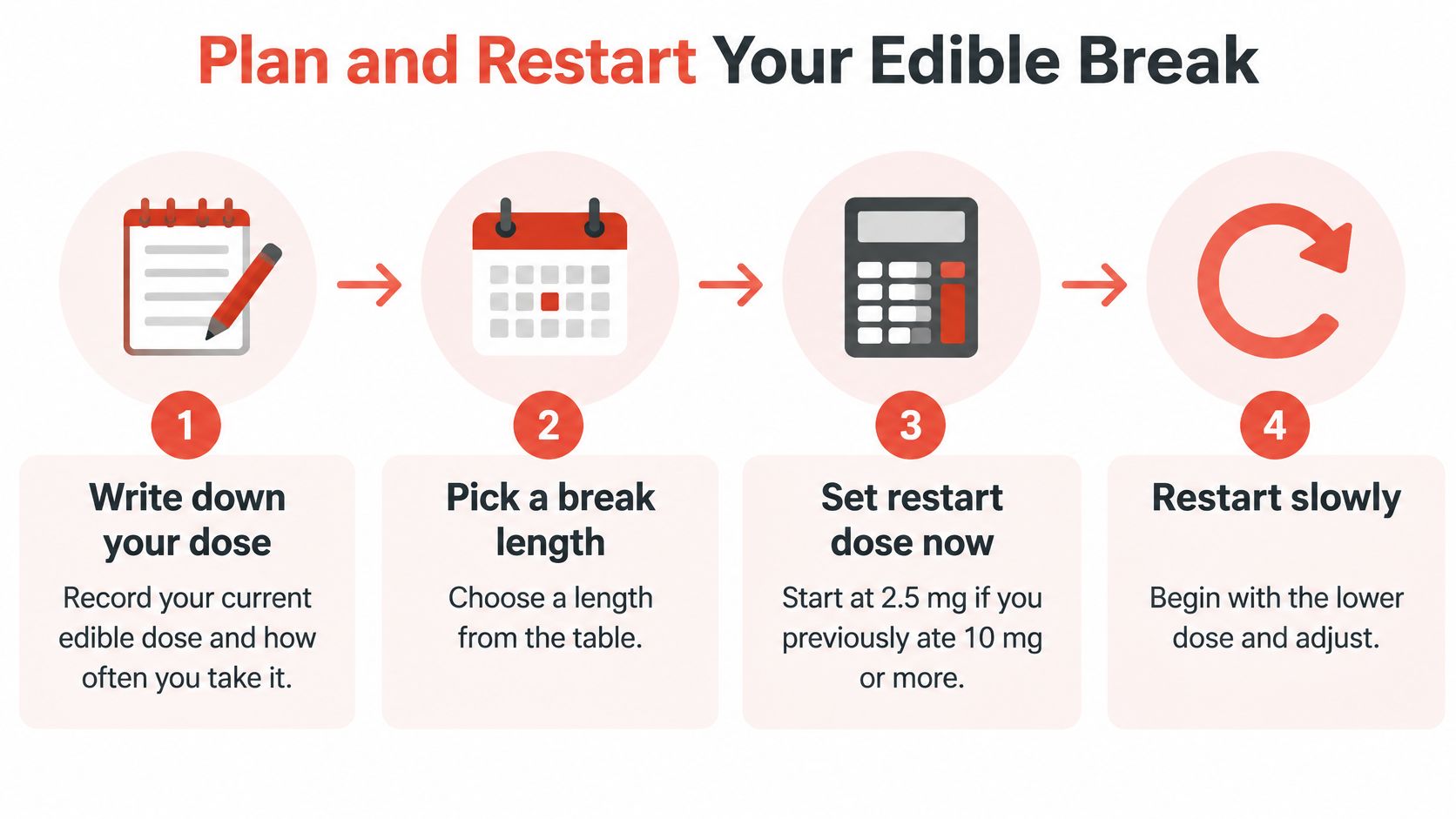
Prepare your surroundings, too. Put products out of immediate reach, tell someone supportive what you're doing, and choose a replacement for your usual dosing ritual.
If you expect sleep or appetite changes, make the practical arrangements in advance. Keep easy food available and avoid scheduling the restart before driving, work, caregiving, or another responsibility that requires unimpaired attention.
A useful restart is modest, predictable, and aligned with your goal, ideally at less than you used before. Feeling dramatically intoxicated isn't necessary to demonstrate that the break changed your response.
If you quickly return to escalating amounts, reconsider the schedule and the reason for use rather than repeating the same experiment indefinitely. A clinician can help separate symptom treatment, habit, and difficulty controlling use.
Set your provisional restart date on the calendar today, with the lower-dose plan written beside it.
At Melt, we offer lab-tested edibles and educational guides to help you understand serving information and approach cannabis more deliberately. Visit Melt to explore our resources and review product details before deciding whether, when, and how to restart.
Your cart is currently empty.