


Free Shipping All Orders Over $95
The advice arrives in one line at the counter. Look for myrcene, because myrcene is the relaxing one, the terpene that puts you on the couch. It shows up on strain pages, jar labels and forum threads, and it's why shoppers scan terpene percentages the way they once scanned for the word indica.
The line isn't wrong so much as unsupported where it matters. Sort the claims about myrcene by the quality of evidence behind them and the order flips. The effect with the most data is pain and inflammation, measured in rats. The effect that sells the most products, sedation, rests on consumer report and on animal work that never produced the drowsiness researchers went looking for.
That gap matters at the point of sale. A terpene percentage is a chemical measurement, real and useful. The effect story stapled to it is usually inherited marketing.
Before you trust any sentence about myrcene, put it next to the evidence behind it. Here's where each commonly claimed effect stands.
| Effect area | Key evidence | Evidence strength |
|---|---|---|
| Pain and inflammation | Rat model, local doses of 1 mg/kg and 5 mg/kg, dose-dependent relief peaking near 120 minutes | Preclinical, moderate |
| Anxiety | Female mice responded after repeated 30-minute vapor exposure; male mice after a single hit | Preclinical, sex-dependent |
| Rodent sedation tests | Mouse antinociception at 10 mg/kg, opioid-linked; no benzodiazepine-like activity at 1 g/kg | Weak, mostly anecdotal |
| Human clinical effects | 2 human studies, both on inhaled essential oils below 25% beta-myrcene | Very limited |
The top row holds the strongest card, and it's a preclinical card. Myrcene applied directly to an inflamed rat joint produced dose-dependent pain relief across a three-hour window, and the relief scaled with dose. That dose-response shape is what you want to see before calling something a real signal rather than noise.
A review of myrcene's anti-inflammatory and anti-nociceptive properties sets the two headlines side by side and reaches a plain verdict. The marketed sedation association has substantially weaker direct evidence than the preclinical analgesic signal, and no human data directly correlate pure beta-myrcene with therapeutic benefits.
The one-sentence version: the best-supported myrcene effect is pain-related and measured in animals, while the most heavily marketed effect is the least proven.
Now look at the sedation row. Mice given 10 mg/kg by intraperitoneal injection showed antinociception, and the effect was blocked by naloxone and yohimbine, which points to opioid and alpha-2-adrenergic pathways rather than to a sedative mechanism. Other rodent neurobehavioral work found no benzodiazepine-like or clearly mind-altering activity even at 1 g/kg. A terpene percentage on a label, in other words, is not a validated predictor of how sleepy or how intoxicated a product will make you.
The anxiety row and the human row explain why so much product copy sounds confident and so little of it can be checked. The human evidence amounts to two studies on inhaled essential oils containing less than 25% beta-myrcene, which is not the same thing as purified myrcene delivered in a controlled dose. When a claim sits in the bottom two rows, treat the label as a description of chemistry and nothing more.
Crush a hop cone between your fingers and the first note is green and resinous, with something sweet underneath. Peel a ripe mango and the same molecule shows up again, softer and fruitier. That's myrcene, one of the most widespread terpenes in the plant kingdom and the reason a fresh bag of flower smells the way it does.
Here's the sensory side of the myrcene terpene effects story, with the two sources encountered first side by side.
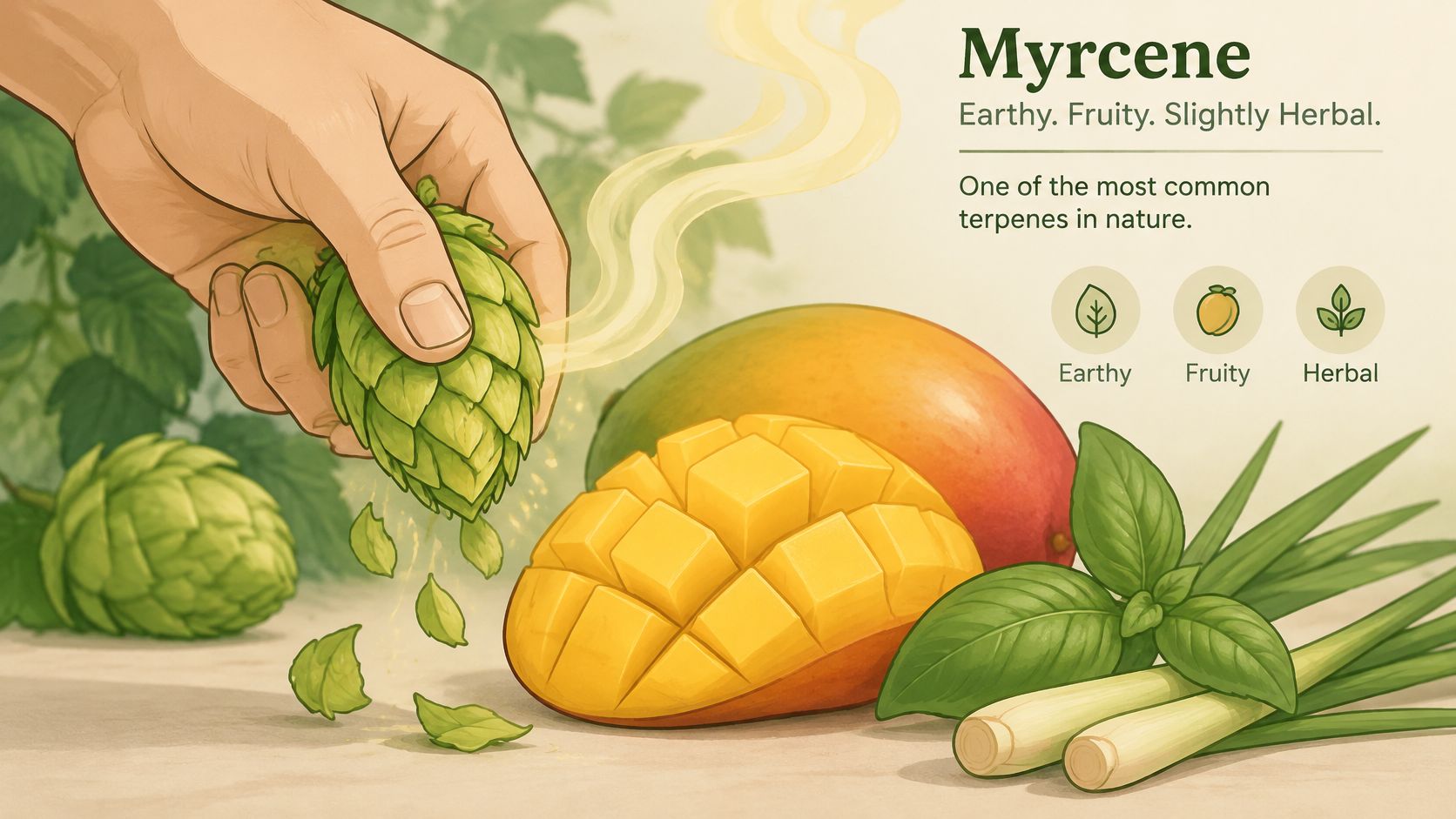
Myrcene, usually written as beta-myrcene on a lab report, is a monoterpene. It appears in cannabis, hops, lemongrass, thyme and bay laurel, and in cannabis it's often the most abundant terpene in the sample. The aroma shifts depending on what else is in the jar, which is why one myrcene-forward product smells like classic flower and another smells closer to a herbal tea.
| Source | Typical aroma | Why readers notice it |
|---|---|---|
| Mango | Ripe, sweet, fruity | Often cited as the classic myrcene aroma |
| Hops | Earthy, resinous, herbal | Familiar from beer, also found in cannabis |
| Lemongrass | Citrus-herbal, fresh | Easy to identify in cooking and teas |
| Thyme | Herbal, warm, earthy | Shows the compound in a common kitchen herb |
| Bay laurel | Spicy, resinous | Used in cooking, so the scent is familiar |
Scent is not a measurement. Two jars can smell nearly identical and sit far apart on cannabinoid content, and a loud aroma tells you nothing about the myrcene percentage inside. The nose detects the presence of a compound, not its concentration relative to everything else.
A practical test. Smell the product, then find the terpene panel and read the myrcene number. That figure describes the batch. It doesn't forecast a mood. If you want to get comfortable reading those panels, start with what terpenes are and how they're reported on cannabis labels, then compare two products on the same shelf using the numbers rather than the names.
That habit changes how you shop. Instead of asking which strain is the sleepy one, you're asking which batch carries which chemistry, and you can answer that question from a document rather than from a budtender's memory.
The single most useful myrcene experiment for a curious consumer is a rat study, and it's worth walking through in order. The model was adjuvant-induced monoarthritis, meaning the animals had an inflamed joint. Myrcene was applied locally at 1 mg/kg and 5 mg/kg, with 8 animals in each treatment group and a 3-hour observation window.
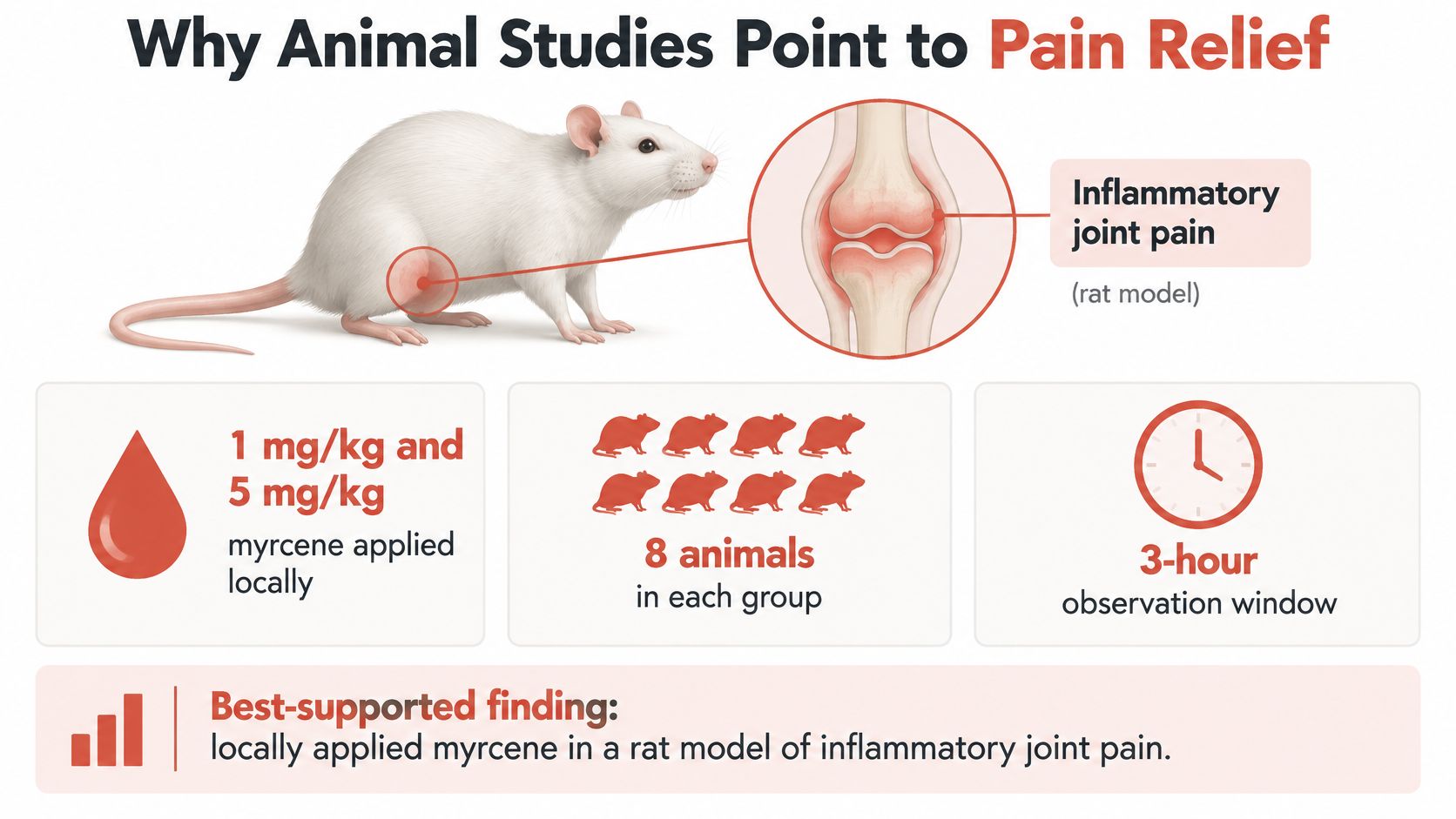
Researchers measured secondary mechanical allodynia, a standard readout for touch-evoked pain. Effects were reported as statistically significant using repeated-measures analysis of variance with a threshold of p < 0.05. The design is conventional and the group size is modest, which is normal for this kind of pharmacology.
The result is where the numbers get interesting. The largest effect landed about 120 minutes after administration. At that point the 1 mg/kg dose improved nociception by 211.0% ± 17.93%, and the 5 mg/kg dose produced an improvement of 269.3% ± 63.27%, as reported in the published preclinical myrcene study. Higher dose, larger effect. The investigators attributed the relief partly to activation of cannabinoid receptors located in the joint itself.
Read those percentages with their scope attached. They are changes in a nociception score in rats, and they say nothing about how much pain a person would feel lift. A rat dose cannot be converted into an inhaled puff, a vape session or an edible. Product concentration, route of administration, metabolism and interactions with other cannabinoids and terpenes all reshape exposure before anything reaches a human receptor.
What the study does establish. Myrcene has a measurable biological basis for influencing inflammatory pain in a living animal, through a mechanism that involves the endocannabinoid system. That's more than most terpene claims can offer.
What it doesn't establish. That a myrcene-rich product will reduce your pain. The pathway from local injection in a rat to inhalation in a person passes through too many variables to skip, and the honest reading is that the data support a hypothesis worth testing in people rather than a therapeutic promise.
Sedation is the effect product pages treat as settled. Ranked by the evidence behind it, it is the weakest claim attached to myrcene. The stronger signal is pain relief in animal models, not a tested sleepy feeling in people.
A 2021 scientific review of beta-myrcene found only 2 human studies involving myrcene-related exposure. Both examined inhalation of plant essential-oil extracts containing less than 25% beta-myrcene. Neither gave purified myrcene in a controlled clinical formulation. The same review reported no randomized, controlled human trials of pure beta-myrcene for pain, sleep, inflammation, anxiety, or sedation, and it called for better-designed clinical work. Human evidence level: two mixed-oil inhalation studies, and no controlled trial of the pure compound. The review also cites animal toxicology benchmarks used to set study doses for fertility and general reproductive performance. Those are laboratory safety estimates, not recommended human intake, and not evidence that a flower will sedate you.
A sedation claim without a human dose-response study behind it is a hypothesis wearing a lab coat.
Injection studies in rodents do not close the gap. They show opioid-linked antinociception, and separate neurobehavioral work found no benzodiazepine-like or clearly mind-altering activity even at very high exposure. Evidence level: preclinical, route-specific, and silent on human sleep. An injection is not an inhaled dose, so those animal results cannot be carried onto a product label.
The practical rule. A high myrcene percentage does not predict how sleepy a product will make you. Dose, route, the other cannabinoids present, and individual response outweigh the terpene figure. If a product page promises sedation from myrcene alone, it is describing an association, not a tested outcome.
Here's the tidy assumption: more myrcene means more relief. The evidence doesn't support the tidiness. Recent UC San Diego–associated preclinical work reported sex-specific antinociceptive effects in a mouse model of neuropathic pain, while stating that the mechanism and its relevance to human pain management remain uncertain, according to the center's report on the myrcene study. Same compound, different response, depending on the animal.
A 45-day study of 38 people with knee osteoarthritis used hemp-seed oil enriched with beta-caryophyllene, myrcene and ginger. The intervention improved pain and function versus a terpene-free control. It's the best human pain signal connected to myrcene so far, and it can't tell you what myrcene did, because three other actives moved alongside it.
That's the credit problem in formulation research. When four ingredients are given together and the group improves, you know the combination helped. You don't know which component carried the effect, whether the components needed each other, or whether one of them was doing all the work while the others rode along.
Picture two purchases. The first is a myrcene isolate or a tincture built around a single terpene. The second is whole flower with THC, a spread of other terpenes and its own cannabinoid ratio. Expect these to behave differently, because they are different exposures, not two versions of one thing.
The flower carries THC, and THC dose is the loudest variable in the room. It also carries terpenes that may reinforce or blunt the myrcene contribution. Lab and animal findings suggest cannabinoid-terpene interactions are real, but standardized human trials haven't pinned down the size of those interactions, which keeps the entourage effect in hypothesis territory.
Track three variables. Biological sex, because the mouse data split on it. Pain type and goal, because inflammatory joint pain and nerve pain are not the same problem. THC exposure, because a product's cannabinoid load shapes the experience more than its terpene percentage does.
What the data supports: a set of testable hypotheses about how myrcene interacts with cannabinoids. Not dose-specific medical recommendations for your body.
Anxiety is the effect product copy mentions least, yet it has one of the most intriguing recent animal results. A 2024 study in Frontiers in Behavioral Neuroscience found that beta-myrcene produced anxiolytic effects in female mice after repeated vapor exposures over 30 minutes, while male mice showed an effect after only a single vapor hit. Sex changed both the threshold and the pattern.
The route deserves plain language. This was inhalation in an animal model, which is closer to how people use cannabis than an injection is. It still isn't a vape pen session or a flower session in a person, and the dosing doesn't transfer.
Then there's the finding that has nothing to do with how you'd feel. A 2023 study in Archives of Microbiology found myrcene had minimum inhibitory concentrations of 25 µg/µl against both Fusarium graminearum and Fusarium culmorum, with half-MIC values of 12.5 µg/µl. That's antifungal activity in a laboratory dish. It says nothing about any benefit from eating, vaping or applying myrcene, and it belongs in a different conversation than the one about your evening.
Check three things in any anxiety claim. The species tested, because mice aren't people. The exposure route, because vapor, injection and oral dosing are not interchangeable. The sex of the animals, because at least one result reversed depending on it. If a page can't answer those three, the claim is decoration.
For the broader picture of how these compounds interact with the body, this explainer on how terpenes work alongside cannabinoids is a reasonable next read.
Five steps, run in order, before any money changes hands. Each one answers a question the label usually leaves open.
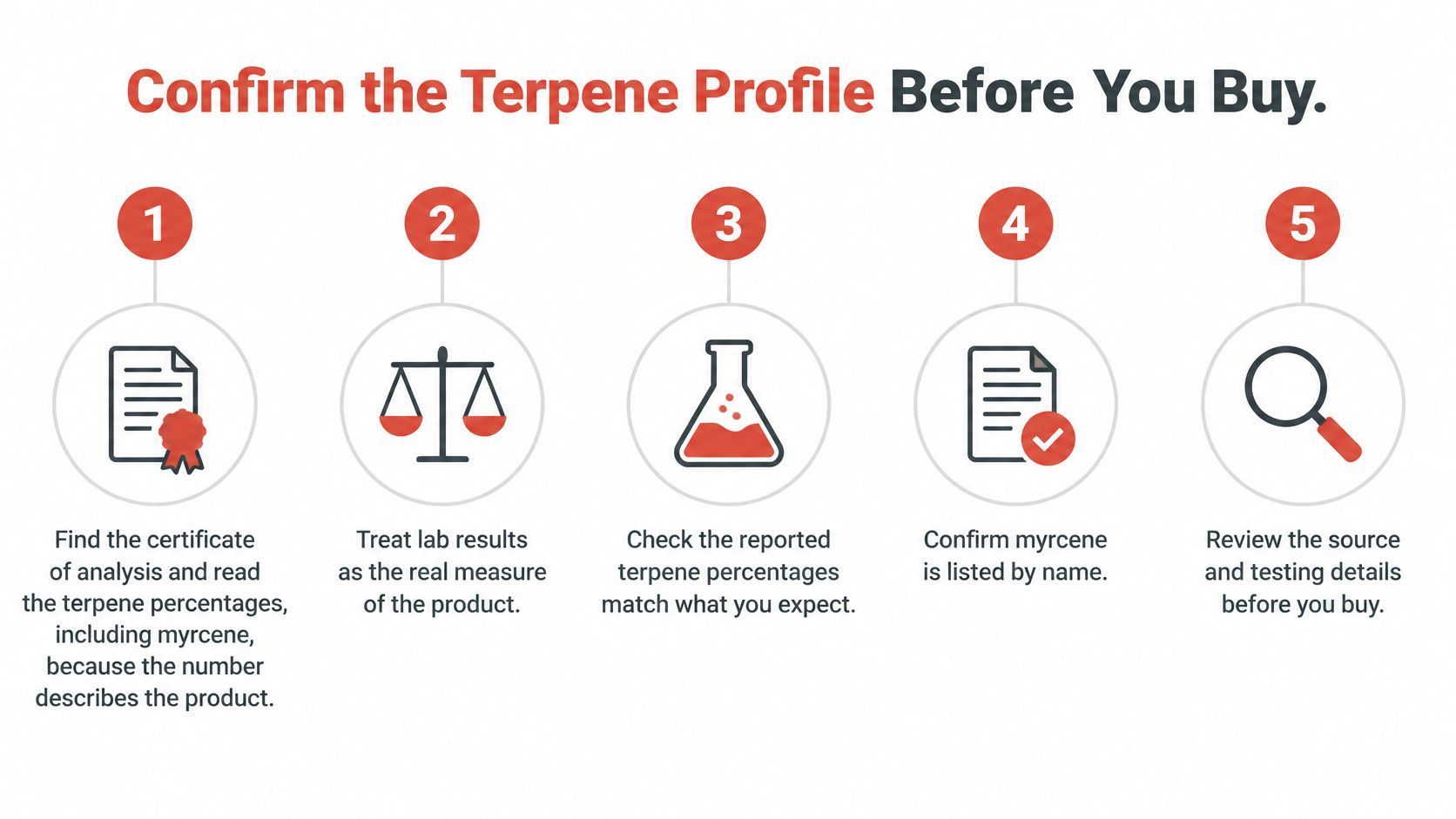
Pick one product, run these five checks against its documentation, and note how you feel across the next few uses. Two or three sessions will teach you more about your own response than any strain description can, and you'll have a record to compare against the next jar.
Melt stocks THCA flower and hand-packed Exotic Prerolls built around strain-specific terpene profiles, so the chemistry you've just learned to read is the same chemistry printed on the label. If you want to put the five-step check to work on a real product page, browse the Melt collection, pull up a certificate of analysis, and compare the myrcene figure against the total profile before you decide.
Your cart is currently empty.